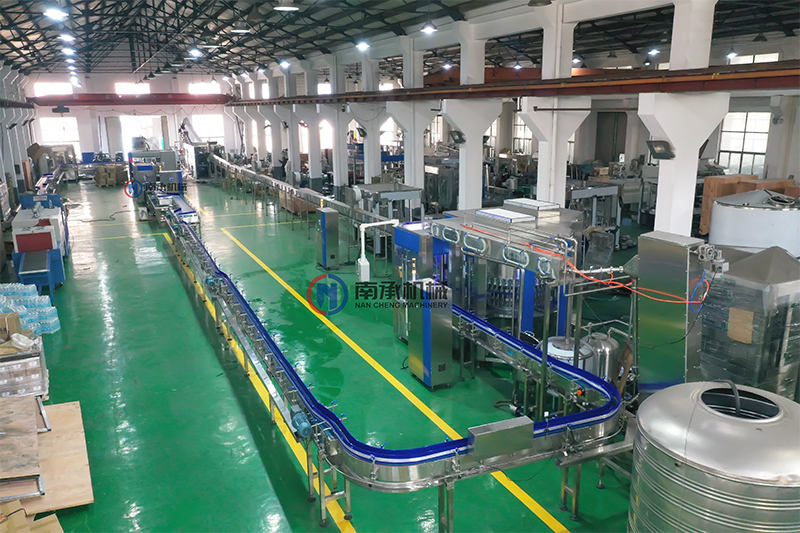
Nancheng Machinery provides automatic beer bottling equipment for different glass bottle sizes, beer types and production requirements. The machine can operate as an independent beer bottle filler or as the central unit of a complete beer bottling line with bottle conveying, pasteurization, inspection, labeling and packaging equipment.
Watch the automatic beer bottling machine in operation, including glass bottle rinsing, CO₂ purging, isobaric filling, controlled pressure release and crown capping.
The video shows the complete working process of the beer bottle filling machine, from empty bottle infeed to finished bottle discharge. It also demonstrates stable bottle handling, controlled foam formation, consistent filling levels and reliable crown cap sealing.
This beer bottling machine can be integrated with bottle conveyors, tunnel pasteurizers, labeling machines, inspection systems and packaging equipment to form a complete automatic beer bottling line.
Automatic Beer Bottling Machine for Sale
A reliable beer bottling system plays an important role in protecting beer flavor, carbonation, and shelf stability during packaging. From small craft breweries to high-output beer factories, choosing the right beer bottling machine for sale can improve production speed, reduce product loss, and maintain consistent filling levels.
In this guide, we explain how beer bottling equipment works, the main stages of the bottling process, and the machines required for a complete beer packaging line. We also compare different filling technologies and introduce practical options for breweries searching for affordable beer bottle fillers, cost-effective beer bottling machines, and economical beer bottling equipment without compromising essential performance.
What Is an Automatic Beer Bottle Filling Machine?
A beer bottle filling machine is specialized packaging equipment used to transfer beer into glass or PET bottles accurately and hygienically before capping. Most modern machines use counter-pressure, also called isobaric filling, to balance the pressure inside the bottle with the filling tank. This helps reduce foaming, preserve carbonation, minimize oxygen pickup, and maintain consistent filling levels.
Depending on the production capacity, a beer bottle filling machine may operate as a standalone filler or as part of a complete rinsing, filling, and capping monoblock. It is widely used by craft breweries, medium-sized beverage plants, and large beer manufacturers that require stable output, reliable packaging quality, and efficient automated production.
What Is the Working Principle of a Beer Bottling Machine?
A beer bottling machine normally uses counter-pressure, or isobaric, filling technology to package carbonated beer without excessive foam or CO₂ loss. By keeping the pressure inside the bottle close to the pressure in the beer tank, the machine supports smooth filling, accurate liquid levels, and better product stability.
The complete working process generally includes the following stages:
Bottle Rinsing and Preparation
Empty bottles are conveyed into the machine and rinsed to remove dust, particles, and possible contaminants. Depending on the production requirements, water rinsing, sterile water, or air rinsing may be used.
CO₂ Flushing
Carbon dioxide is introduced into the bottle to reduce the amount of air and oxygen inside. Lower oxygen exposure helps protect the beer from oxidation, flavor changes, and shorter shelf life.
Pressure Equalization
The bottle is gradually pressurized until its internal pressure is close to that of the beer storage tank. This controlled pressure balance prevents sudden beer expansion and limits foam formation.
Beer Bottling Machine Filling Valve Options
Mechanical Valve Beer Bottling Machine
A mechanical valve beer bottling machine uses cams, springs, pressure differences, and fixed mechanical timing to control bottle pressurization, beer filling, and pressure release. It is known for its simple structure, reliable operation, and relatively low maintenance requirements. This type of machine is suitable for breweries that produce the same beer and bottle format for long production runs. However, process adjustments are mainly completed manually, so flexibility is limited when beer temperature, carbonation level, or bottle size changes frequently. Mechanical valve systems are a practical choice for stable production conditions and cost-conscious brewery projects.
Semi-Electronic Valve Beer Bottling Machine
A semi-electronic valve beer bottling machine combines mechanical liquid-level control with PLC-controlled pneumatic functions. Parameters such as CO₂ purging, bottle pressurization, filling time, settling time, and pressure release can be adjusted through the control panel. The final filling level is usually controlled by a return-air tube or another mechanical structure. Compared with a mechanical valve system, this design provides better foam control, easier recipe adjustment, and more consistent filling performance. It is well suited to craft and medium-sized breweries that handle several beer varieties or bottle formats but do not require a fully electronic filling system.
Electronic Valve Beer Bottling Machine
An electronic valve beer bottling machine uses PLC-controlled solenoid valves and pneumatic actuators to manage each stage of the filling cycle independently. CO₂ purging, pressure equalization, beer flow, filling stages, settling, and controlled snifting can be programmed for different products. Depending on the machine configuration, filling quantity may be controlled by a return-air tube, flowmeter, or electronic measuring system. Production recipes can be stored for different beer temperatures, carbonation levels, and bottle sizes. This technology offers greater flexibility, precise process control, and improved production monitoring, making it suitable for modern breweries with frequent changeovers and demanding filling requirements.
Pressure Release and Valve Closing
After the required filling level is reached, the beer valve closes. The remaining pressure is then released gradually to prevent bubbling, splashing, or product loss.
Capping and Sealing
The filled bottle is transferred immediately to the capping station. Crown caps or other closures are positioned and securely applied to maintain carbonation and prevent contamination.
Inspection and Packaging
Finished bottles may pass through fill-level inspection, cap inspection, labeling, date coding, pasteurizing, and final packaging before shipment.
Breweries with limited investment budgets can also consider an affordable beer bottle filler or cost-effective beer bottling machine. However, price should be evaluated together with filling accuracy, oxygen control, hygienic design, automation level, and long-term operating reliability.
How Does a Beer Bottling Machine Work?
A beer bottling machine completes several coordinated operations to fill bottles efficiently while protecting carbonation, flavor, and product hygiene. Depending on the equipment configuration, rinsing, filling, and capping may be integrated into one automatic monoblock or handled by separate machines.
The typical beer bottling process includes the following steps:
1. Bottle Feeding and Washing
Empty glass bottles are loaded onto the conveyor and delivered continuously to the rinsing section. The bottles are inverted and rinsed internally to remove dust, glass particles, and other possible contaminants.
The rinsing method may use treated water, sterile water, or another approved cleaning medium according to the brewery’s hygiene requirements. After rinsing, the bottles are drained and transferred to the filling station.
2. CO₂ Purging and Bottle Pressurization
Before beer enters the bottle, carbon dioxide may be injected to displace part of the air inside. Reducing the oxygen content helps limit oxidation, which can otherwise affect beer aroma, color, taste, and shelf life.
The bottle is then pressurized gradually until its internal pressure is close to the pressure inside the beer tank. This pressure balance is essential for controlling foam and preventing sudden CO₂ release during filling.
3. Counter-Pressure Beer Filling
Once pressure equalization is complete, the filling valve opens and beer flows gently into the bottle under counter-pressure, also known as isobaric filling.
As the beer level rises, the gas inside the bottle returns through the vent tube. This controlled process helps preserve dissolved carbon dioxide, reduce product loss, and maintain a consistent filling level across all bottles.
Depending on the machine design, filling may be controlled by a mechanical valve, semi-electronic valve, or fully electronic filling system.
4. Pressure Release and Bottle Transfer
After the target filling level is reached, the liquid valve closes. The remaining bottle pressure is released slowly through a controlled snifting process.
Gradual pressure release prevents excessive foaming, beer overflow, and unstable liquid levels. The filled bottles are then transferred quickly to the capping section to minimize oxygen exposure.
5. Automatic Capping and Sealing
Crown caps are sorted, fed, positioned, and pressed securely onto the bottle neck. A properly adjusted capping system helps prevent leakage, carbonation loss, and external contamination.
Different production scales may use different equipment options, including:
Cheap beer bottle capping machine for small breweries with limited output
Cheap beer bottle filling machine for startup or pilot-scale production
Automatic beer bottling line for medium- and high-capacity breweries
Compact beer bottling system for facilities with restricted floor space
6. Inspection, Labeling, and Final Packaging
After capping, the bottles can pass through inspection equipment that checks the liquid level, cap position, seal condition, and internal pressure. Bottles that do not meet the preset quality requirements are automatically rejected.
Qualified bottles may then continue through bottle warming, tunnel pasteurizing, drying, labeling, date coding, and packaging. Finished beer bottles can be packed in cartons, shrink film, trays, or crates for storage and distribution.
Breweries searching for affordable equipment may consider a cheap small-scale beer bottling machine or a cost-effective beer bottling system. However, the purchase decision should not be based on price alone. Filling stability, oxygen control, hygienic construction, changeover requirements, spare-parts availability, and after-sales support should also be evaluated.
What Equipment Is Needed to Make Beer?
A complete beer production system includes equipment for water preparation, malt processing, wort brewing, fermentation, cooling, cleaning, and final packaging. The exact configuration depends on the brewery’s production capacity, available floor space, beer varieties, and level of automation.
Large industrial breweries may use a separate vessel for each production stage, while craft breweries often select combined brewing vessels and multipurpose fermentation tanks to reduce investment and save space.
The main equipment normally includes:
Water Treatment System – Removes unwanted minerals, chlorine, particles, and other impurities from the brewing water. Since water makes up most of the finished beer, its mineral composition can directly influence flavor, fermentation performance, and product consistency.
Hot Liquor Tank (HLT) – Stores and heats brewing water for mashing, lautering, equipment cleaning, and sparging. Accurate hot-water temperature control is essential for stable starch conversion and wort extraction.
Cold Liquor Tank (CLT) – Stores chilled brewing water used during wort cooling. In an energy-recovery system, water heated by the plate heat exchanger can be returned to the HLT and reused for the next brewing cycle.
Malt Mill – Crushes malted barley into a controlled mixture of husks, grits, and flour. Proper milling improves sugar extraction while keeping enough husk structure for efficient wort filtration.
Mash Tun – Mixes crushed malt with temperature-controlled water. During mashing, natural enzymes convert malt starches into fermentable sugars.
Lauter Tun – Separates the liquid wort from the spent grain after mashing. The grain bed acts as a natural filter while additional hot water is sprayed over it during sparging.
Brew Kettle – Boils the wort with hops to develop bitterness, aroma, flavor, and color. Boiling also sterilizes the wort, removes undesirable volatile compounds, and stops enzymatic activity.
Whirlpool Tank – Creates a controlled rotating flow that separates hop particles, proteins, and other solids from the hot wort before cooling.
Combined Brewing Vessels for Craft Breweries
Small and medium-sized breweries do not always need an independent vessel for every stage. Common compact brewhouse configurations include:
Mash/Lauter Tun – Combines mashing and wort filtration in one vessel.
Kettle/Whirlpool Tank – Performs wort boiling and solid separation in the same tank.
Two-Vessel Brewhouse – Commonly combines a mash/lauter tun with a kettle/whirlpool tank.
Three- or Four-Vessel Brewhouse – Separates more process stages to support higher batch frequency and greater production efficiency.
Combined vessels can reduce equipment cost, installation space, piping complexity, and cleaning requirements. However, because different processes share the same tank, the number of brews completed per day may be lower than with a fully separated brewhouse.
Plate Heat Exchanger – Rapidly cools boiled wort to the correct yeast-pitching temperature. A single-stage or two-stage plate heat exchanger may use cold water, chilled water, or glycol-assisted cooling, depending on the brewery design. Heat recovered during wort cooling can also be reused in the HLT.
Fermentation Tanks – Hold the cooled wort while yeast converts fermentable sugars into alcohol, carbon dioxide, and characteristic beer flavors. Modern tanks are usually constructed with conical bottoms and cooling jackets.
Unitanks – Multipurpose cylindroconical tanks that can support primary fermentation, yeast collection, dry hopping, cooling, clarification, maturation, and carbonation in the same vessel. Unitanks are especially popular in craft breweries because they reduce beer transfers, lower oxygen exposure, and may eliminate the need for a separate bright beer tank.
Bright Beer Tank – Used for final clarification, carbonation, pressure stabilization, short-term storage, and supplying beer to the packaging line. A separate bright beer tank is valuable when high packaging output is required, but it may not be essential when properly designed unitanks are used.
Glycol Chiller – Produces and circulates a chilled glycol-water solution through the cooling jackets of fermentation tanks, unitanks, and bright beer tanks. This system maintains precise temperatures during fermentation, cold crashing, maturation, and beer storage.
Air Compressor and CO₂ System – Supplies compressed air for pneumatic components and carbon dioxide for tank pressure control, purging, carbonation, and counter-pressure filling.
CIP Cleaning System – Circulates water and cleaning solutions through tanks, pipelines, valves, heat exchangers, and filling equipment without complete disassembly. A typical CIP system may include hot-water, caustic, acid, and recovery tanks.
Beer Filtration or Separation Equipment – Depending on the beer style, the brewery may use cartridge filters, membrane filters, diatomaceous-earth filters, or centrifugal separators to improve clarity and stability. Unfiltered craft beer may bypass this stage.
Beer Bottling System – Packages finished beer into glass or PET bottles. A complete line may include bottle rinsing, CO₂ purging, counter-pressure filling, crown capping, fill-level inspection, pasteurizing, labeling, coding, and final packaging.
Kegging or Canning Equipment – Breweries that use multiple packaging formats may also require keg washers and fillers, can rinsers, isobaric can fillers, seamers, and can inspection equipment.
For a startup or microbrewery, an entry-level bottle filler, manual counter-pressure filler, semi-automatic beer bottle filling machine, or compact filling solution may provide a practical starting point. However, equipment selection should not be based only on the initial purchase price.
Even small-scale beer filling equipment should be evaluated for hygienic construction, carbonation retention, filling consistency, reliable sealing, and low dissolved-oxygen pickup. A cost-effective system that controls oxygen and product loss can provide better long-term value than a low-priced machine that reduces beer shelf life or creates unstable packaging quality.
Beer Bottling Machine Technology And Specifications
Explore additional beer bottling machine for sale options below. Nancheng Machinery provides compact, semi-automatic, and fully automatic beer filling systems for different bottle materials, production capacities, and brewery sizes.
Specification
NC8-8-3
NC12-12-5
NC18-18-6
NC24-24-8
NC32-32-10
NC Semi-Automatic
Suitable Products
Beer, carbonated beverages, soda, sparkling water and other carbonated drinks
Beer, carbonated beverages, soda, sparkling water and other carbonated drinks
Beer, carbonated beverages, soda, sparkling water and other carbonated drinks
Beer, carbonated beverages, soda, sparkling water and other carbonated drinks
Beer, carbonated beverages, soda, sparkling water and other carbonated drinks
Beer, craft beer and other carbonated beverages
Applicable Containers
Glass bottles, PET bottles, aluminum bottles and metal bottles
Glass bottles, PET bottles, aluminum bottles and metal bottles
Glass bottles, PET bottles, aluminum bottles and metal bottles
Glass bottles, PET bottles, aluminum bottles and metal bottles
Glass bottles, PET bottles, aluminum bottles and metal bottles
Glass bottles and PET bottles
Production Capacity
1,500 BPH
2,500 BPH
5,000 BPH
8000 BPH
10,000 BPH
200–800 BPH
Bottle Volume Range
100 ml–1 L
100 ml–1 L
100 ml–1 L
100 ml–1 L
100 ml–1 L
Customized according to bottle size
Common Bottle Sizes
180 ml, 250 ml, 330 ml, 355 ml, 440 ml, 500 ml, 8 oz, 12 oz, 16 oz and 1 L
180 ml, 250 ml, 330 ml, 355 ml, 440 ml, 500 ml, 8 oz, 12 oz, 16 oz and 1 L
180 ml, 250 ml, 330 ml, 355 ml, 440 ml, 500 ml, 8 oz, 12 oz, 16 oz and 1 L
180 ml, 250 ml, 330 ml, 355 ml, 440 ml, 500 ml, 8 oz, 12 oz, 16 oz and 1 L
180 ml, 250 ml, 330 ml, 355 ml, 440 ml, 500 ml, 8 oz, 12 oz, 16 oz and 1 L
250 ml, 330 ml, 500 ml and customized formats
Installed Power
Customized
2.2 kW
1.5 kW
1.5 kW
Customized
0.3 kW
Approximate Dimensions
Customized
2.5 × 1.9 × 2.3 m
2.2 × 1.8 × 2.55 m
2.5 × 1.4 × 2.5 m
Customized
2.0 × 0.7 × 2.0 m
Approximate Weight
Customized
3,500 kg
3,500 kg
4,500 kg
Customized
150 kg
Automation Level
Automatic
Automatic
Automatic
Automatic
Fully automatic
Semi-automatic
What Technologies Are Used in Modern Beer Production?
Modern beer production combines brewing, filtration, carbonation, microbiological stabilization and low-oxygen packaging technologies. The correct process depends on the beer style, required shelf life, distribution conditions and desired flavor profile.
For example, a brewery producing fresh unpasteurized beer may use sterile cold filtration, while a large brewery distributing beer at ambient temperature may select flash or tunnel pasteurization. These technologies should therefore be presented as different production routes rather than processes that must always be used together.
1. Cold Microfiltration and Sterile Filtration
Cold microfiltration removes residual yeast, bacteria and fine suspended particles from beer through membrane or cartridge filtration without applying a high-temperature treatment.
Depending on the target microorganisms, beer characteristics and system validation, breweries may use final-filter ratings around 0.2–0.45 μm. A validated 0.45 μm membrane is commonly used for brewery sterile-filtration applications, while a 0.2 μm membrane may be selected when more stringent microbial retention is required. Pore size alone does not prove sterility; filter validation, integrity testing and hygienic downstream operation must also be confirmed.
Because the beer is processed at a low temperature, sterile cold filtration can better preserve delicate hop aromas and fresh flavor characteristics that may be affected by thermal treatment.
Typical applications include:
Unpasteurized draft or draught beer
Premium lager
Fresh craft beer
Alcohol-free and low-alcohol beer
Beer intended for hygienic or aseptic filling
Cold sterile filtration and pasteurization are commonly treated as alternative microbiological stabilization methods. Alfa Laval, for example, recommends either flash pasteurization or sterile filtration as possible shelf-life protection routes for alcohol-free beer.
However, sterile filtration only works reliably when the downstream product tank, piping, filler and packaging environment are designed and operated hygienically. A filtration system alone cannot prevent contamination introduced after the filter.
2. Beer Pasteurization Technology
Pasteurization uses controlled heat treatment to reduce or deactivate yeast and spoilage microorganisms, improving microbiological stability and extending beer shelf life.
The two main commercial methods are flash pasteurization and tunnel pasteurization.
Flash Pasteurization
Flash pasteurization, also called short-time beer pasteurization, treats the beer before packaging. The product passes through a plate heat exchanger, is rapidly heated for a controlled holding period and is then cooled before entering the filling system.
Products requiring controlled treatment before packaging
Because the beer is pasteurized before filling, the downstream filler and product path must be hygienically designed to avoid recontamination. Commercial flash-pasteurization systems are available for bottle, can and keg filling applications.
Tunnel Pasteurization
Tunnel pasteurization takes place after beer has been filled and sealed.
Bottles or cans travel through a spray tunnel containing several heating, pasteurization and cooling zones. The process is controlled according to pasteurization units rather than temperature alone.
Tunnel pasteurization is widely used for:
Industrial bottled beer
Canned beer
Products distributed without a continuous cold chain
Beer requiring long ambient-temperature shelf life
Because the package is already sealed, tunnel pasteurization can also control microorganisms introduced during filling and closure. Modern tunnel systems use controlled pasteurization-unit management to match different products and package sizes.
Flash and tunnel pasteurization are not interchangeable without reviewing the filling environment. Flash pasteurization treats the beer before filling, whereas tunnel pasteurization treats the beer and its sealed package after filling.
3. Automated Inline Carbonation
Traditional brewery carbonation may be performed by introducing CO₂ slowly through a sintered carbonation stone inside a fermentation or bright beer tank.
Modern automated systems can instead carbonate beer continuously in the product-transfer pipeline.
An inline carbonation system normally includes:
A controlled beer flow
A CO₂ dosing valve
A gas injector or mixing device
A static mixer or controlled contact section
Inline CO₂ measurement
PLC or PID closed-loop control
CO₂ is injected into the flowing beer and distributed as fine bubbles to promote rapid dissolution. The control system continuously compares the measured carbonation level with the recipe setpoint and adjusts CO₂ dosing accordingly.
This provides:
More consistent carbonation
Faster product adjustment
Reduced tank residence time
Improved recipe repeatability
More efficient CO₂ consumption
Easier switching between beer styles
GEA describes continuous carbonation systems that use a specialized injection process for precise and efficient CO₂ dosing. Inline instruments are also available for real-time measurement of dissolved CO₂ and oxygen in beer.
Carbonation may be expressed in g/L or volumes of CO₂, depending on the brewery and target market.
4. Low-Oxygen Counter-Pressure Filling
Automatic beer packaging technology should not be evaluated only by production speed. The more important objective is to transfer beer into the bottle, can or keg while controlling foam, retaining carbonation and minimizing oxygen pickup.
For carbonated beer, the principal technology is counter-pressure, or isobaric, filling.
The typical filling sequence is:
Bottle or can positioning
Air evacuation or CO₂ pre-purging
Container pressurization
Pressure equalization
Counter-pressure beer filling
Filling stabilization
Controlled pressure release
Immediate capping or can seaming
For glass bottles, an advanced filling cycle may use two or more pre-evacuation steps with intermediate CO₂ flushing. Air is repeatedly evacuated and replaced with CO₂ before beer filling begins.
Aluminum cans cannot normally be vacuum-treated in the same way as rigid glass bottles because thin empty cans may deform. Can filling lines therefore generally rely on one or more CO₂ purge cycles, controlled filling and rapid lid placement.
Counter-pressure systems use CO₂ to remove most of the oxygen from the package before filling, helping limit beer contact with air.
Key packaging indicators include:
Dissolved oxygen before filling
Oxygen pickup across the filler
Headspace oxygen
Total package oxygen
Beer temperature
Carbonation retention
Filling-level consistency
Bottle-cap or can-seam quality
An optimized beer packaging line may target oxygen pickup in the tens of parts per billion, but the acceptable value should be defined according to the beer style, required shelf life, package type and brewery quality standard. Values such as 30–50 ppb should be treated as demanding project targets subject to confirmed product conditions, upstream oxygen levels, container specifications and commissioning results, rather than as a universal guarantee for every filling line.
Comparison of Modern Beer Production Technologies
Technology
Main Function
Key Technical Point
Typical Application
Cold Microfiltration
Removes yeast and microorganisms without heat
Uses validated membrane or cartridge filtration, commonly around 0.2–0.45 μm depending on the microbial-retention target
Fresh beer, unpasteurized beer and hygienic filling
Flash Pasteurization
Stabilizes beer before filling
Short-time heat treatment through a plate heat exchanger
Kegs and hygienic bottle or can filling lines
Tunnel Pasteurization
Stabilizes beer after packaging
Sealed bottles or cans pass through controlled spray-heating and cooling zones
Industrial bottled and canned beer
Inline Carbonation
Controls dissolved CO₂ continuously
CO₂ injection, mixing and real-time measurement with closed-loop control
Lager, craft beer, hard seltzer and alcohol-free beer
Low-Oxygen Isobaric Filling
Retains carbonation and limits oxygen pickup
CO₂ purging or evacuation, pressure equalization and controlled filling
Glass bottles, aluminum cans and kegs
Choosing the Right Beer Bottling Machine
The best beer bottling machine should match your brewery’s output, bottle format, available space, and future expansion plan. Instead of focusing only on the purchase price, buyers should also consider filling performance, oxygen control, operating stability, and maintenance requirements.
Key factors include:
Required Production Output – Estimate the number of bottles that must be filled per hour and allow additional capacity for future growth.
Level of Automation – Manual and semi-automatic machines are suitable for small breweries, while fully automatic bottling lines are more efficient for continuous commercial production.
Bottle and Closure Compatibility – Confirm whether the machine can handle glass bottles, PET bottles, crown caps, screw caps, or other packaging formats.
Beer Characteristics – Carbonation level, filling temperature, foam tendency, and product viscosity can influence the required filling-valve design.
Oxygen and CO₂ Control – A reliable counter-pressure filling system should minimize dissolved-oxygen pickup, reduce foaming, and preserve beer carbonation.
Changeover Requirements – Breweries producing several bottle sizes should evaluate the time and parts required to adjust guides, star wheels, filling heights, and capping components.
Investment and Operating Cost – Entry-level craft beer bottling equipment may be suitable for startups, while medium and large breweries usually benefit from a more automated commercial beer bottling line.
A cost-effective machine is not simply the lowest-priced option. The right system should provide consistent filling, secure sealing, hygienic operation, accessible spare parts, and dependable long-term performance.
Why Choose Nancheng Machinery for Beer Bottling Equipment?
Nancheng Machinery designs and manufactures beverage filling and packaging equipment for international projects.
Our beer bottling solutions focus on:
Customized machine configuration
Glass bottle handling
Isobaric filling technology
Crown capping integration
Complete production-line planning
Bottle and change-part confirmation
Electrical configuration for the destination country
Factory testing before shipment
Installation and commissioning support
Operator training
Spare-parts supply
Long-term technical service
Instead of selecting equipment only from a standard catalog, our engineering team evaluates the bottle, closure, beer parameters, production target and factory conditions before confirming the final solution.
Conclusion
A well-designed beer bottling machine helps breweries protect carbonation, reduce oxygen exposure, improve filling consistency, and increase packaging efficiency. Whether the project involves a small craft brewery or a high-capacity commercial beer plant, the equipment should be selected according to bottle type, production speed, automation level, hygiene requirements, and future expansion plans.
When comparing a beer bottling machine for sale or a complete beer bottling line for sale, buyers should consider more than the initial price. Filling stability, reliable capping, low product loss, easy maintenance, and dependable technical support all contribute to long-term operating value. Choosing the right beer bottling system can improve product quality, reduce production costs, and support sustainable brewery growth.
Frequently Asked Questions
What is a beer bottling machine?
A beer bottling machine is automatic equipment used to fill beer into bottles and seal them for storage and distribution. A rotary glass bottle system normally integrates rinsing, isobaric filling and crown capping.
What is the difference between a beer bottling machine and a beer bottle filling machine?
The two terms often describe the same core equipment. “Beer bottle filling machine” emphasizes the filling function, while “beer bottling machine” may also refer to rinsing, capping and complete line integration.
Why is beer filled under counter pressure?
Beer contains dissolved carbon dioxide. Counter-pressure filling helps control pressure changes during filling, reducing excessive foaming and carbonation loss.
Can the machine fill craft beer?
Yes. The machine can be configured for craft beer, lager, ale, wheat beer, stout and other carbonated beer products. The beer temperature, carbonation and filling pressure must be confirmed before commissioning.
Can one machine handle different glass bottle sizes?
Yes, provided that suitable change parts and adjustment systems are included. Different bottle diameters, heights and shapes may require replacement star wheels, guide plates and other format parts.
Which bottle information is required before ordering?
The manufacturer needs bottle samples, technical drawings, bottle height, diameter, neck finish, crown cap specification and target fill level.
Does the machine support returnable beer bottles?
The filler can process suitable returnable bottles after they have been correctly washed and inspected. Dirty returnable bottles normally require a separate bottle washer rather than only a rotary rinser.
What type of cap does the machine use?
The standard configuration uses crown caps. The exact crown cap diameter, liner, metal specification and bottle neck finish must be confirmed before manufacturing the cap handling and capping system.
How does the machine reduce oxygen exposure?
Depending on the machine configuration, the process may use pre-evacuation, CO₂ purging, controlled pressure filling and rapid capping. Stable upstream beer preparation and correct machine operation are also necessary.
Can the beer bottling machine be cleaned by CIP?
The beer-contact tank, valves and piping can be designed with a CIP-compatible cleaning circuit. The final cleaning method, chemical concentration, temperature and cycle time should follow the brewery’s sanitation procedure.
Is a tunnel pasteurizer necessary?
Not every beer product requires the same pasteurization process. The need for a tunnel pasteurizer depends on beer formulation, filtration, filling hygiene, microbiological control and required shelf life.
What production capacities are available?
Different rotary configurations are available for small, medium and larger commercial projects. The final capacity should be selected according to bottle size, daily production plan, packaging speed and expected line efficiency.
How much does an automatic beer bottling machine cost?
The price depends on output, bottle formats, valve configuration, component brands, inspection systems and the scope of the complete line. An accurate quotation requires bottle and production information.
Can Nancheng supply a complete beer bottling line?
Yes. The project can include bottle handling, rinsing or washing, isobaric filling, crown capping, inspection, pasteurization, labeling, coding, carton packing, shrink wrapping and palletizing.
What information is needed for a quotation?
Provide the beer type, target capacity, bottle volume, bottle samples, crown cap specification, beer temperature, carbonation level, factory layout, destination country and required packaging method.
Request a Beer Bottling Machine Quotation
Planning a new brewery or upgrading an existing glass bottle line?
Send us your bottle samples, beer parameters, required production capacity and factory layout. Nancheng Machinery will prepare a customized beer bottling machine configuration and complete line proposal for your project.
 English
 العربية
 Français
 Русский
 Español
 Português
 Deutsch
 italiano
 Nederlands
 Tiếng Việt
 ไทย
ไทย Polski
 Türkçe
 አማርኛ
አማርኛ Bahasa Melayu
 Filipino
 Bahasa Indonesia
 magyar
 Română
 Čeština
 Монгол
 қазақ
қазақ Српски
 हिन्दी
 فارسی
فارسی Kiswahili
 Slovenčina
 Slovenščina
 Norsk
Norsk Svenska
 українська
 Suomi
Suomi Հայերեն
 Dansk
Dansk اردو
اردو Shqip
Shqip বাংলা
বাংলা Hrvatski
 Eesti keel
 සිංහල
සිංහල नेपाली
 Oʻzbekcha
 latviešu
 Azərbaycan dili
 Български
 ქართული
 Hausa
Hausa Igbo
Igbo Lietuvių
 Soomaali
 Yorùbá