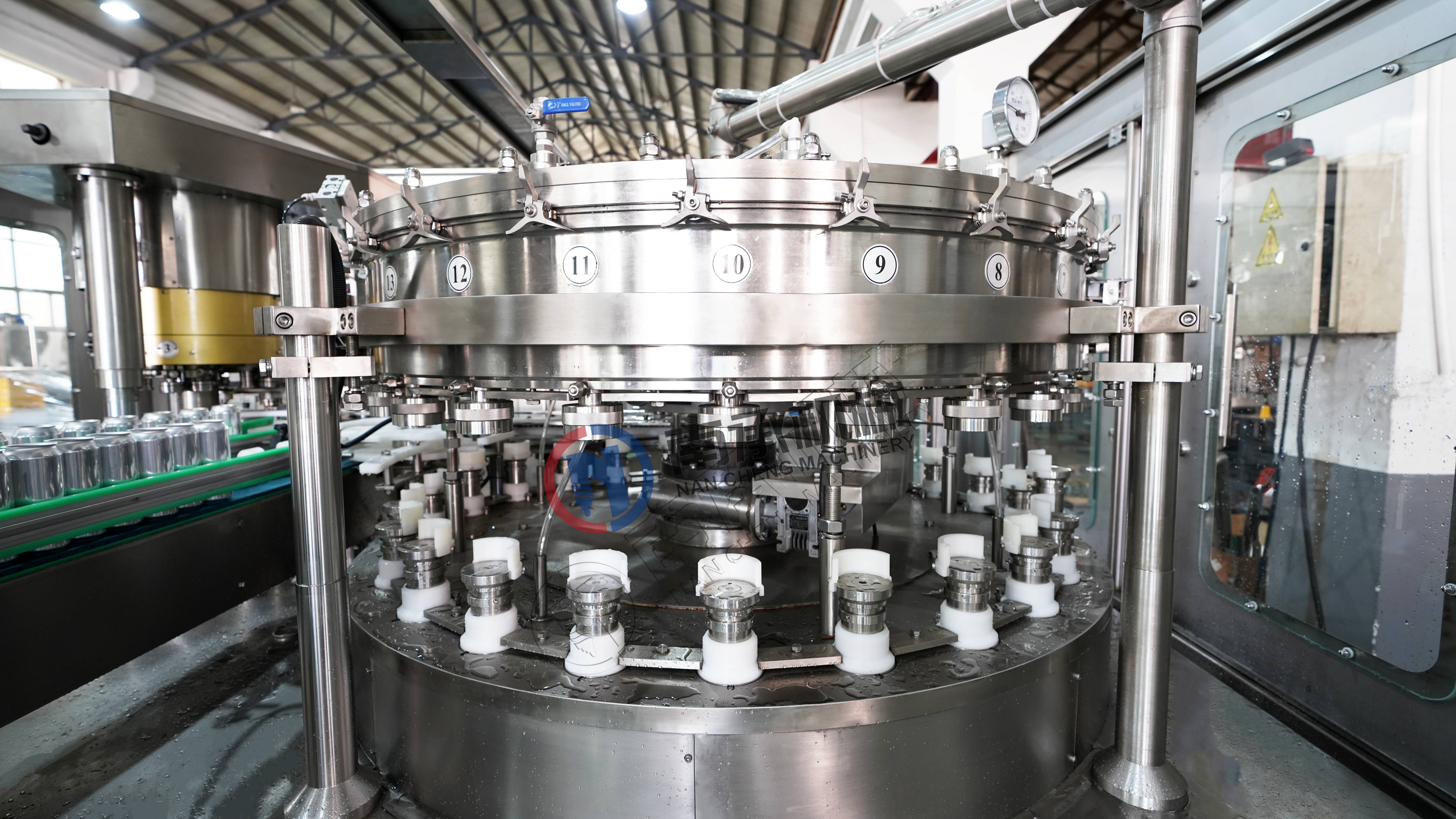
A beer canning machine is an automatic packaging system used to fill carbonated beer into aluminum cans and close each package with an easy-open lid. A complete machine normally integrates CO₂ purging, counter-pressure filling, automatic lid placement and double seaming.
This video shows a complete automatic beer canning line equipped with an 18-4 beer can filling and seaming machine. The machine has 18 filling valves and 4 seaming heads, with a reference production capacity of approximately 3,000 to 5,000 cans per hour, depending on the can format and beer-filling conditions.
The complete production line includes:
18-4 automatic beer can filling and seaming machine
Can liquid level inspection machine
Can internal pressure inspection machine
Spray pasteurizer
Inkjet coding machine
PE film shrink wrapping machine
During production, empty aluminum cans enter the filling machine for CO₂ purging, counter-pressure beer filling, automatic lid feeding and double seaming. The sealed cans then pass through the liquid level inspection system to detect underfilled or overfilled products.
The internal pressure inspection machine checks whether the pressure inside each sealed can is within the required range. Unqualified cans can be automatically rejected before entering the downstream process.
After inspection, the cans enter the spray pasteurizer for controlled heating, pasteurization and cooling. The inkjet printer applies the production date, batch number or expiration information to each can.
Finally, the finished beer cans are grouped and wrapped by the PE film shrink wrapping machine, producing stable packages for storage and transportation.
What Is a Beer Canning Machine?
A beer canning machine is an automatic packaging system used to fill carbonated beer into aluminum cans and close each package with an easy-open lid. A complete machine normally integrates CO₂ purging, counter-pressure filling, automatic lid placement and double seaming.
Nancheng Machinery supplies automatic beer canning machines with 18, 24, 30 and 36 filling heads for craft breweries, regional beer producers and commercial beverage factories. The equipment can operate as an independent beer filler-seamer or as the main unit of a complete beer canning line.
What Is the Working Principle of a Beer Canning Machine?
The working principle of a beer canning machine is based on controlled-pressure filling followed by immediate lid placement and double seaming.
Cold beer is stored in a pressurized product tank. Empty cans are delivered to the filling carousel and positioned below the filling valves.
CO₂ Purging
CO₂ is introduced into each empty can before filling.
The purpose is to displace part of the surrounding air and reduce the amount of oxygen present inside the package. Depending on the machine configuration, the CO₂ purge time or number of purge steps can be adjusted.
CO₂ purging should not be described as creating a completely oxygen-free can. Some residual air may remain, and oxygen can also enter during product transfer, filling, foaming and lid placement.
Standard thin-wall beverage cans are generally purged with CO₂ rather than subjected to the bottle-style vacuum pre-evacuation cycles used for rigid glass containers.
Pressure Equalization
The can is raised and sealed against the filling valve.
CO₂ is introduced until the pressure inside the can approaches the pressure inside the beer tank. This reduces the pressure difference that the beer experiences when the product valve opens.
Isobaric Beer Filling
Once the pressure is balanced, the beer valve opens.
Beer flows into the can under controlled pressure. Depending on the valve design, the filling process may include a fast main-filling stage and a slower finishing stage.
The filling level or volume can be controlled mechanically, electronically or through a metering system, depending on the selected equipment.
Settling and Pressure Release
When filling is complete, the product valve closes.
A short settling period may be used before the pressure inside the can is reduced. The controlled release of pressure is often called snifting.
If the pressure is released too quickly, the beer may foam out of the can. If it is released too slowly, the machine cycle becomes longer and production capacity may decrease.
Foam Control and Lid Placement
Before lid placement, controlled foam may be created to help displace air from the can headspace.
Depending on the brewery’s process, foam may be encouraged through the natural beer-filling conditions, a controlled product jet or a high-pressure jet of suitable deaerated process water.
Liquid nitrogen dosing is not normally required for standard carbonated beer because dissolved CO₂ provides internal package pressure. However, if the same canning line is also configured for still beverages such as cold-brew coffee, non-carbonated tea or still juice in standard thin-wall aluminum cans, an LN₂ doser may be required to generate internal pressure and improve can rigidity. The final requirement should be confirmed according to the can specification, filling process and target package pressure.
After foam control, the lid is placed onto the can as quickly as possible.
Double Seaming
The can enters the seaming station.
First-operation rollers form the can-body flange and lid curl. Second-operation rollers compress the formed seam to create the final closure.
The finished double seam must provide sufficient mechanical strength and package integrity to retain the beer and internal pressure.
Beer Canning Machine Models and Technical Specifications
Nancheng Machinery provides automatic beer canning machines with 18, 24, 30 and 36 filling heads. Each model combines counter-pressure filling, automatic lid feeding and double seaming for beer and other carbonated beverages.
Model
NC18-4
NC24-4
NC30-6
NC36-6
Filling Heads
18
24
30
36
Seaming Heads
4
4
6
6
Application
Beer, carbonated beverages, hard cider, soda water, sparkling water and other suitable carbonated drinks
Beer, carbonated beverages, hard cider, soda water, sparkling water and other suitable carbonated drinks
Beer, carbonated beverages, hard cider, soda water, sparkling water and other suitable carbonated drinks
Beer, carbonated beverages, hard cider, soda water, sparkling water and other suitable carbonated drinks
Packaging Type
Aluminum cans and compatible metal beverage cans
Aluminum cans and compatible metal beverage cans
Aluminum cans and compatible metal beverage cans
Aluminum cans and compatible metal beverage cans
Reference Speed
3,000–5,000 CPH
5,000–8,000 CPH
8,000–12,000 CPH
12,000–15,000 CPH
Filling Volume
180 ml, 250 ml, 330 ml, 355 ml, 440 ml, 473 ml, 500 ml and customized formats
180 ml, 250 ml, 330 ml, 355 ml, 440 ml, 473 ml, 500 ml and customized formats
180 ml, 250 ml, 330 ml, 355 ml, 440 ml, 473 ml, 500 ml and customized formats
180 ml, 250 ml, 330 ml, 355 ml, 440 ml, 473 ml, 500 ml and customized formats
Filling Method
Counter-pressure or isobaric filling
Counter-pressure or isobaric filling
Counter-pressure or isobaric filling
Counter-pressure or isobaric filling
Reference Power
Approx. 3.5 kW
Approx. 4.5 kW
Approx. 5.5 kW
Approx. 7.5 kW
Reference Dimensions
Approx. 2.6 × 1.8 × 2.1 m
Approx. 2.9 × 2.0 × 2.2 m
Approx. 3.2 × 2.2 × 2.3 m
Approx. 3.5 × 2.4 × 2.4 m
Reference Weight
Approx. 2,800 kg
Approx. 3,500 kg
Approx. 4,200 kg
Approx. 5,000 kg
Main Material
SUS304, with SUS316 product-contact options
SUS304, with SUS316 product-contact options
SUS304, with SUS316 product-contact options
SUS304, with SUS316 product-contact options
Control System
PLC and touch screen
PLC and touch screen
PLC and touch screen
PLC and touch screen
Cleaning
CIP-compatible product circuit
CIP-compatible product circuit
CIP-compatible product circuit
CIP-compatible product circuit
How Does a Beer Canning Machine Work?
An automatic beer canning machine combines empty-can handling, CO₂ purging, counter-pressure filling, lid placement, double seaming and downstream packaging into one continuous production process.
Empty-Can Feeding and Rinsing
Empty aluminum cans are supplied manually or by an automatic depalletizer. They pass through an inline can rinser, where treated water or ionized air removes loose dust and particles.
The cans are then returned to an upright position and transferred smoothly to the filling carousel.
CO₂ Purging and Pressurization
Before filling, CO₂ is introduced into each can to displace part of the surrounding air.
The can is raised and sealed against the filling valve. It is then pressurized until its internal pressure approaches the pressure inside the beer tank. This pressure equalization helps reduce sudden CO₂ breakout when the product valve opens.
Isobaric Mechanical Valve Filling
Mechanical isobaric valves use cams, springs, gas passages and liquid-level control components to manage the filling cycle.
They are durable, relatively simple to maintain and suitable for breweries producing stable beer recipes over long production runs. Most operating adjustments are completed mechanically.
Semi-Electronic Valve Filling
Semi-electronic valves combine mechanical liquid control with programmable pneumatic or electronic timing.
Operators can adjust CO₂ purging, can pressurization, valve opening, fast filling, slow filling, settling and pressure release through the PLC or touch screen.
This configuration provides greater flexibility when processing beers with different temperatures, carbonation levels or foaming characteristics.
Settling, Snifting and Foam Control
After the required filling level is reached, the product valve closes and the beer is allowed to settle briefly.
The pressure is then released gradually through a process called snifting. Controlled pressure release helps prevent excessive beer overflow.
Stable foam may also be created before lid placement to help displace oxygen-containing air from the can headspace.
Automatic Lid Feeding and Double Seaming
An automatic lid feeder places one easy-open lid onto each filled can.
First-operation rollers form the can flange and lid curl. Second-operation rollers compress the formed layers to create the final double seam.
The can body, lid and seaming tooling must be correctly matched to maintain package integrity.
Inspection and Pasteurization
Sealed cans can pass through exterior rinsing, liquid-level inspection, internal-pressure inspection and automatic rejection.
A tunnel or spray pasteurizer may also be installed when the beer requires thermal stabilization.
Coding and Final Packaging
After rinsing or pasteurization, the cans are dried and printed with production dates, batch numbers or traceability information.
Blank cans may also pass through a labeling machine. Finally, the cans are grouped by a PE film shrink wrapper or carton packing machine before palletizing, storage and transportation.
Upstream Craft Brewing Integration for Stable Beer Canning
A beer canning machine is part of the packaging section, but its performance depends heavily on the upstream brewing and beer-supply system. Stable beer temperature, carbonation, dissolved oxygen, bright-beer-tank pressure and product flow are essential for consistent filling speed, foam control and package quality.
Water Quality Control: Water treatment equipment removes impurities and creates a stable brewing-water profile.
Efficient Malt Preparation: A malt mill crushes grain to support effective mashing and lautering.
Consistent Wort Production: Mash tuns, lauter tuns, kettles and whirlpool tanks control the main brewing stages.
Stable Fermentation: Fermentation tanks and glycol cooling systems maintain suitable yeast activity and temperature.
Improved Beer Quality: Bright beer tanks, filtration and stabilization equipment prepare beer for packaging.
Automated Packaging: Beer canning machines, seamers, inspection systems and packing equipment improve output and consistency.
Reliable Cleaning: A CIP system cleans tanks, pipes and filling circuits efficiently.
Before the beer enters the canning machine, it should be supplied from the bright beer tank at a stable temperature and pressure. Beer is commonly canned at approximately 0–4°C, although the actual setting should be determined according to the beer style, carbonation level and filling-valve design. Unstable supply pressure or excessive product temperature may cause CO₂ breakout, excessive foaming, fill-level variation and reduced production speed.
Combined Brewing Vessels for Craft Breweries
Space-Saving Design: Combined vessels perform several brewing functions in fewer tanks, reducing the required installation area.
Lower Initial Investment: Two-vessel systems can reduce equipment, piping and installation costs for small breweries.
Flexible Configurations: Common layouts include a combined mash-lauter tun with a kettle-whirlpool vessel.
Simplified Operation: Shorter piping routes and fewer tanks make operation, cleaning and maintenance easier.
Suitable Craft Capacity: Combined brewhouses are practical for breweries producing a limited number of batches each day.
Production Limitations: Shared vessels cannot perform every process simultaneously, which may increase the time between batches.
Balanced Line Design: Brewhouse output, fermentation capacity and beer canning speed should be matched to prevent equipment from operating below capacity.
What Technologies Are Used in Modern Beer Production?
Automated Brewing Control: PLC systems manage temperatures, pumps, valves and recipe timing for more repeatable production.
Accurate Fermentation Control: Cooling jackets, glycol systems and temperature sensors maintain stable yeast activity.
DO and TPO Monitoring: Oxygen measurement helps control dissolved oxygen, headspace oxygen and total package oxygen.
Flexible Filling Control: Semi-electronic valves allow operators to adjust purging, pressurization, filling and snifting times.
Controlled Foam Formation: Stable foam before lid placement helps displace air from the can headspace.
Automatic Quality Inspection: Sensors can detect incorrect fill levels, missing lids, abnormal pressure and coding defects.
Efficient CIP Cleaning: Automated cleaning systems circulate controlled solutions through tanks, piping and filling valves.
Tunnel Pasteurization: Controlled heating and cooling improve microbiological stability while limiting unnecessary heat exposure.
Choosing the Right Beer Canning Machine
Selecting a suitable beer canning machine requires more than comparing prices or maximum operating speed. Breweries should evaluate the complete production process before making a decision.
Required Output: Choose a machine that matches your actual hourly and daily production targets. A compact beer canning system may be sufficient for a growing craft brewery, while larger producers may require a fully automatic line with higher output and continuous operation.
Investment and Operating Cost: The total beer canning machine cost includes more than the purchase price. Breweries should also consider energy use, spare parts, maintenance, labor requirements and future expansion costs.
Can and Product Compatibility: Confirm that the machine can process your beer type, filling temperature, carbonation level, can dimensions and lid specifications. Different can formats may require additional change parts or seaming tooling.
Production-Line Integration: The filler and seamer should connect smoothly with existing tanks, conveyors, pasteurizers, inspection systems and packaging machines. A balanced line helps prevent bottlenecks and improves overall production efficiency.
Technical Support: Select a supplier that can provide factory testing, installation guidance, operator training and long-term spare-parts support.
Why Choose Nancheng Machinery for Beer Canning Machine?
Customers can purchase an individual beer canning machine for sale or request a turnkey line covering brewing, fermentation, can filling, inspection, pasteurization and final packaging.
Before manufacturing, the technical team confirms the beer parameters, can format, lid specification, factory layout and required output.
This engineering-based approach helps reduce incorrect machine selection, unstable filling and unnecessary changeover costs.
Conclusion
A beer canning machine is the central packaging unit for breweries producing canned lager, ale, IPA, stout, cider, alcohol-free beer and other carbonated products.
A reliable machine should provide stable CO₂ purging, controlled-pressure filling, consistent foam management, accurate lid placement and properly formed double seams.
The machine must also match the actual beer temperature, carbonation level, can dimensions, lid specifications and downstream production capacity.
Nancheng Machinery supplies automatic beer canning machines and complete beer can filling lines for craft breweries and commercial beer factories.
Send your required capacity, beer parameters, can drawings, lid samples and factory layout to receive a customized technical proposal and beer canning machine quotation.
Frequently Asked Questions
What is a beer canning machine?
A beer canning machine fills beer into metal cans and seals each can with an easy-open lid. It normally combines CO₂ purging, counter-pressure filling, lid placement and double seaming.
What is the difference between a beer canning machine and a beer can filling machine?
A beer can filling machine refers mainly to the liquid-filling section. A beer canning machine generally includes both beer filling and can seaming.
Why is counter-pressure filling used for beer?
Counter-pressure filling reduces the pressure difference between the beer tank and the can. This helps control foam and retain more dissolved carbonation.
Can CO₂ purging remove all oxygen from a can?
No. CO₂ purging can reduce the amount of air in the can, but it does not create a completely oxygen-free package.
Final oxygen levels also depend on incoming beer DO, foam control, lid placement and seaming.
What is the difference between DO and TPO?
DO is oxygen dissolved in the beer.
TPO includes the oxygen in both the beer and the sealed package headspace.
A beer can have low incoming DO but still develop a higher TPO value during filling and seaming.
Can the machine use vacuum pre-evacuation?
Standard thin-wall beverage cans are generally filled using CO₂ purging and pressure equalization rather than the bottle-style vacuum cycles commonly used for rigid glass bottles.
Does beer canning require liquid nitrogen dosing?
Liquid nitrogen is not normally required for standard carbonated beer.
Beer already contains CO₂ and typically uses CO₂ purging, controlled foaming, under-lid gassing and rapid lid placement to manage headspace oxygen.
If the same line is used for non-carbonated beverages in thin-wall cans, liquid nitrogen dosing may be added to create internal pressure and reduce the risk of paneling or can deformation.
Can one machine handle different can sizes?
Yes, but additional change parts may be required.
Different can heights, diameters and lid specifications may require different guide rails, lifting components, transfer parts and seaming tooling.
What information is required about the can and lid?
The supplier should receive physical samples and technical drawings showing can height, diameter, flange dimensions, lid diameter and lid curl specification.
What is double seaming?
Double seaming mechanically joins the can body and lid.
First-operation rollers form the seam, and second-operation rollers compress it to create the final closure.
How is double-seam quality checked?
Quality checks may include visual inspection, leak testing and seam teardown.
Typical measurements include seam width, seam thickness, body hook, cover hook, overlap and countersink depth.
Does the beer canning line need a tunnel pasteurizer?
Not every beer requires tunnel pasteurization.
The requirement depends on beer style, filtration, hygiene control, distribution conditions and shelf-life target.
Can the beer canning machine connect to an existing brewery?
Yes. The machine can be integrated with existing bright beer tanks, conveyors, pasteurizers and packaging equipment after the factory layout and control interfaces are reviewed.
What production capacity is available?
Reference rotary configurations range from approximately 3,000 to 15,000 cans per hour, or about 50 to 250 cans per minute, depending on the machine model, can size, beer temperature, carbonation level and complete-line configuration.
Other capacities can be evaluated according to can size and complete-line requirements.
How much does a beer canning machine cost?
The price depends on capacity, filling-valve design, seaming heads, can formats, component brands and the scope of downstream equipment.
What information is needed for a quotation?
Please provide the beer type, required output, can and lid samples, filling temperature, carbonation level, packaging method, factory layout, destination country and electrical standard.
 English
 العربية
 Français
 Русский
 Español
 Português
 Deutsch
 italiano
 Nederlands
 Tiếng Việt
 ไทย
ไทย Polski
 Türkçe
 አማርኛ
አማርኛ Bahasa Melayu
 Filipino
 Bahasa Indonesia
 magyar
 Română
 Čeština
 Монгол
 қазақ
қазақ Српски
 हिन्दी
 فارسی
فارسی Kiswahili
 Slovenčina
 Slovenščina
 Norsk
Norsk Svenska
 українська
 Suomi
Suomi Հայերեն
 Dansk
Dansk اردو
اردو Shqip
Shqip বাংলা
বাংলা Hrvatski
 Eesti keel
 සිංහල
සිංහල नेपाली
 Oʻzbekcha
 latviešu
 Azərbaycan dili
 Български
 ქართული
 Hausa
Hausa Igbo
Igbo Lietuvių
 Soomaali
 Yorùbá