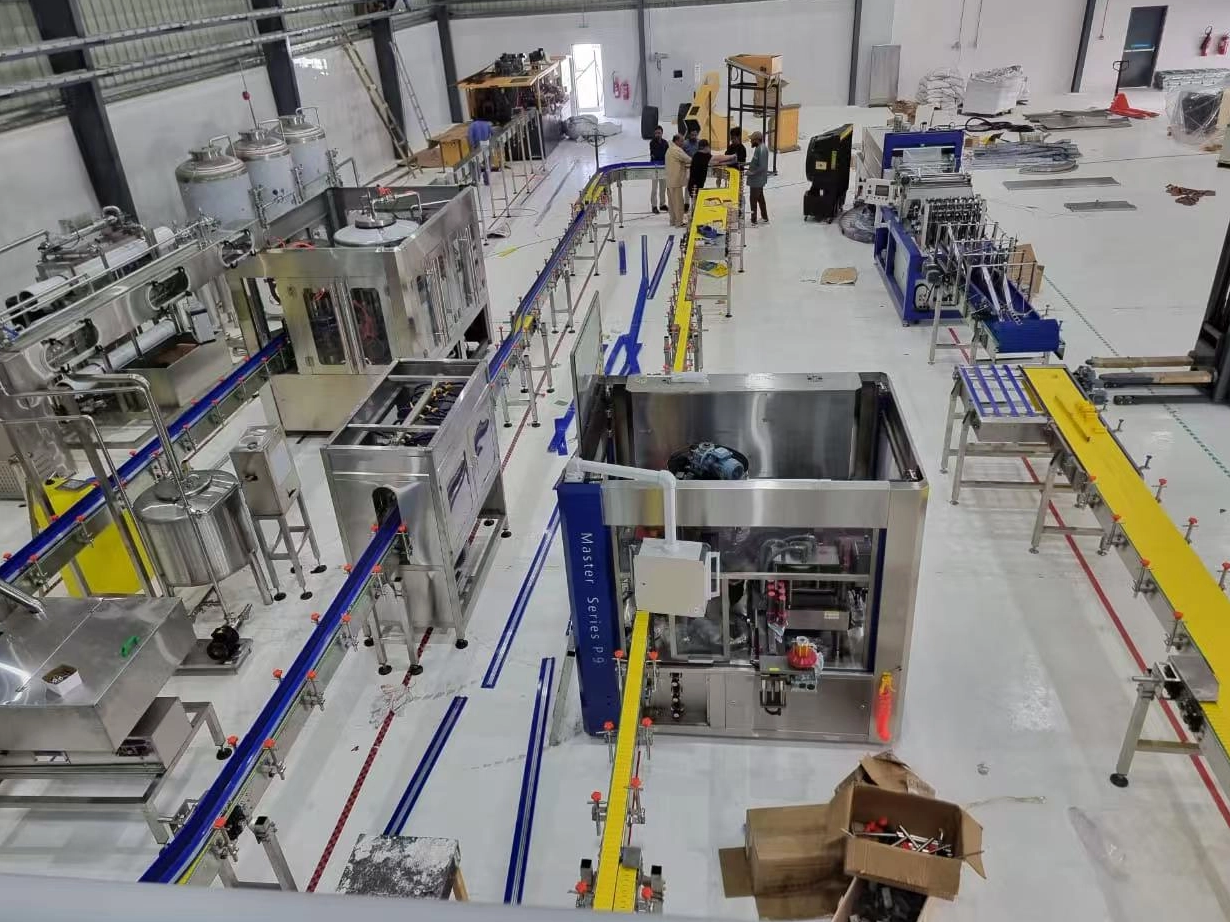
You are here:Home » News » 2000 BPH Automatic Vs Semi-Automatic Water Production Line: Which Is Right for Your Small Factory?
2000 BPH Automatic Vs Semi-Automatic Water Production Line: Which Is Right for Your Small Factory?
Views: 0 Author: Site Editor Publish Time: 2026-09-14 Origin: Site
For a small bottled-water factory, 2,000 bottles per hour is a practical entry point between labor-intensive small-batch production and higher-speed industrial bottling.
At this capacity, both automatic and semi-automatic equipment can be considered, but they operate very differently.
A semi-automatic line keeps the initial investment relatively low and uses simpler machinery, but more production steps depend on operators. An automatic line connects rinsing, filling, capping and bottle transfer into a more continuous process, reducing manual handling and improving production consistency.
The correct choice therefore depends on more than the rated speed of the filler.
Production volume, working shifts, labor availability, investment budget, maintenance capability and future expansion should all be evaluated before the equipment configuration is finalized.
What Is the Main Difference Between Automatic and Semi-Automatic Water Lines?
The main difference is the level of integration between production stages.
In a semi-automatic line, rinsing, filling, capping and downstream packaging are more likely to operate as separate processes. Workers load bottles, move containers between stations and support cap handling, labeling or packing according to the selected configuration.
This structure keeps machinery relatively simple and allows a small factory to begin production with lower capital investment. It also gives operators more direct control over individual production steps.
The trade-off is greater dependence on labor.
When several operations depend on manual bottle transfer, the practical output of the line is affected by operator speed, coordination and fatigue.
An automatic line uses a different production architecture.
For PET bottled water, rinsing, filling and capping are normally integrated into a continuous 3-in-1 monoblock. Bottles move through the main filling section without being manually transferred between each process, while conveyors connect upstream and downstream equipment.
This reduces interruptions between operations and makes production more repeatable.
For investors planning a complete water bottling plant, the automation decision should therefore be evaluated at complete-line level rather than by comparing two filling machines in isolation.
Operational Capacity & Bottlenecks: From Rated 2000 BPH to Stable Saleable Output
A 2,000 BPH rating describes nominal machine capacity. It does not automatically mean the factory will produce 2,000 finished bottles during every hour of a production shift.
This distinction is especially important for semi-automatic production.
At this speed, bottles must move continuously through rinsing, filling, capping, labeling and packing. When operators are responsible for transferring bottles between several independent stations, the speed of manual handling becomes part of the production cycle.
A semi-automatic system may perform well during shorter runs, but maintaining the same output for an entire shift requires consistent bottle feeding, cap handling and finished-product removal.
Automatic production removes many of these manual transfer points.
The rinser, filler and capper operate as one coordinated machine, while conveyors maintain bottle movement between production sections. As a result, the line depends less on workers to maintain the basic production rhythm.
This normally makes an automatic configuration more suitable when stable output close to the design capacity is required for long operating periods.
The Filler Is Not Always the Bottleneck
A 2,000 BPH filler can only maintain its output when the rest of the line supports the same production rate.
Bottle supply must remain stable. Treated water must be available continuously. Caps must reach the capper without interruption. The labeler and shrink wrapper must also process bottles fast enough to prevent excessive downstream accumulation.
If one of these processes operates consistently below the filling rate, it becomes the effective capacity limit of the line.
This is why a professional water filling machine manufacturer should evaluate complete-line capacity rather than simply recommend a filler based on nominal BPH.
Bottle Size Also Changes the Engineering Requirement
The same 2,000 BPH target can represent very different water demand.
A factory producing small 500 mL bottles requires significantly less treated-water flow than a plant running 1.5 L or 2 L bottles at the same bottle count.
Larger bottles also require longer filling time and place different demands on bottle handling and downstream packaging.
For this reason, capacity selection should always include bottle volume, bottle dimensions and required daily output.
Cost and Investment: Evaluating CAPEX, Operating Cost and Total Cost of Ownership
Semi-automatic equipment normally has a lower purchase price because the production process uses simpler standalone machines and less automated bottle transfer.
Automatic lines cost more because they require greater mechanical and electrical integration, more conveying equipment and a more coordinated control system.
For planning purposes, the original 2,000 BPH project comparison can be summarized as follows:
Investment Item
Semi-Automatic 2000 BPH Line
Automatic 2000 BPH Line
Indicative Complete-Line Investment
USD 20,000–40,000
USD 80,000–150,000
Initial CAPEX
Lower
Higher
Bottle Transfer
More manual
Integrated conveying
Direct Labor Requirement
Higher
Lower
Control Integration
Basic / separate
Centralized
Maintenance Complexity
Lower
Higher
Future Expansion
More limited
Better platform
Best Investment Profile
Startup / market testing
Stable commercial production
These figures should be treated as planning ranges rather than fixed quotations. The final investment changes significantly according to project scope, bottle blowing, water treatment, labeling, secondary packaging, utilities, freight and installation.
Do Not Compare Filler Price With Complete-Line Price
This is one of the most common mistakes in small water projects.
One supplier may quote only the filling machine, while another quotation includes water treatment, bottle blowing, conveying, labeling and packaging.
The second quotation appears much more expensive, but the project boundaries are not comparable.
A proper commercial comparison should first confirm exactly what is included in each quotation.
Initial Investment Is Only Part of the Cost
A semi-automatic line reduces the amount of capital required at the beginning of the project, which can be important when a new bottled-water brand is still testing market demand.
An automatic line requires more capital but can reduce direct labor dependence and improve production stability over a longer operating period.
The economic comparison should therefore include equipment investment, labor, electricity, compressed air, spare parts, maintenance and production downtime.
This is the basis of Total Cost of Ownership rather than purchase-price comparison alone.
For a plant operating one short shift with inexpensive local labor, semi-automatic equipment may remain commercially attractive.
For a plant operating multiple shifts with established sales volume, the labor and production benefits of an automatic system become more significant.
Labor and Workforce: Comparing Operator Requirements and Production Dependence
Labor is one of the clearest differences between the two configurations.
A semi-automatic line requires workers to participate directly in more production stages. Depending on the equipment layout, the team may load bottles, move containers between machines, handle caps, support labeling and transfer finished products to the packing area.
The original project design estimated roughly 5–8 workers per shift for a more manually operated semi-automatic setup, compared with approximately 1–2 direct line operators around a highly integrated automatic configuration. Actual manpower should still be calculated from the complete factory scope rather than treated as a fixed rule.
Automatic production changes the operator's role.
Instead of continuously transferring individual bottles, workers spend more time monitoring machine operation, replenishing packaging materials, checking finished-product quality and responding to abnormal conditions.
This improves production consistency because the basic line speed depends less on how quickly individual operators move bottles.
Labor Availability Can Be More Important Than Wage Level
Low labor cost does not always mean manual production is the best choice.
Factories may also face difficulties with staff turnover, operator training, night-shift availability and inconsistent performance between production teams.
If stable staffing is difficult to maintain, automatic production can reduce one of the major operational uncertainties.
Where skilled and reliable labor is readily available, the economic advantage of semi-automatic production can remain stronger.
The automation decision should therefore consider both labor cost and labor reliability.
Maintenance and Scalability: Technical Support, Spare Parts and Future Capacity Expansion
Semi-automatic machinery generally uses simpler mechanical and pneumatic structures.
Routine servicing is therefore easier for factories with basic maintenance capability. Common maintenance work focuses on filling components, seals, pneumatic parts, moving assemblies and normal wear items.
Automatic equipment requires a broader maintenance skill set because mechanical movement, sensors, drives and machine controls work as one integrated system.
The practical difference is not that automatic equipment is inherently unreliable.
The difference is that troubleshooting requires the technician to understand how mechanical, electrical and pneumatic functions interact.
A sensor fault, bottle-transfer problem or control signal can stop production even when the filling mechanism itself is mechanically sound.
For this reason, documentation and technical support become more important as automation increases.
The supplier should provide clear electrical documentation, operating instructions, recommended wear parts and a practical spare-parts package for the installed configuration.
Maintenance Should Be Planned Around Downtime
The cost of a spare part is often much smaller than the cost of lost production.
Critical wear components and commonly replaced electrical or pneumatic parts should therefore be identified before the line enters commercial operation.
Factories located far from the equipment supplier should pay particular attention to parts that are difficult to source locally.
This approach reduces the risk that a relatively small component causes an unnecessarily long production interruption.
Scalability Is Where Automatic Lines Gain an Advantage
Semi-automatic production works well when the factory intends to remain around its original operating scale.
Expansion becomes more difficult when market demand rises significantly.
Adding more workers cannot indefinitely increase output because bottle transfer, machine cycle time and workstation capacity eventually become fixed constraints.
Automatic production provides a stronger base for future development.
The factory can more easily integrate faster labeling, automatic shrink packaging, improved bottle inspection, higher-capacity bottle blowing or additional downstream automation.
This does not mean every new factory should immediately install the most expensive automatic line.
It means that expected production growth should be considered before the original layout is finalized.
How Water Treatment, Bottle Supply and Packaging Affect a 2000 BPH Line
A filling machine cannot operate independently from the systems around it.
Water treatment must provide sufficient finished water at stable quality and flow. Bottle supply must keep the filler continuously fed. Labeling and secondary packaging must remove finished bottles fast enough to prevent downstream accumulation.
For smaller bottles, the packaged-water volume at 2,000 BPH is relatively modest. As bottle volume increases, water-treatment output must increase accordingly.
This should be calculated from the complete production plan rather than by applying one standard water-treatment capacity to every 2,000 BPH project.
The same principle applies to PET bottle blowing.
If bottles are manufactured from preforms inside the plant, the blowing system must have enough practical output to support the filling line continuously. High-pressure compressed-air capacity also becomes part of the production design.
A small bottling project should therefore be engineered as a connected system:
water preparation, bottle supply, filling, labeling and finished-product packaging must support one another at the intended production rate.
Which 2000 BPH Water Production Line Is Better for Your Factory?
Neither configuration is automatically the right solution for every project.
A semi-automatic line is generally more suitable when the factory is entering a new market, initial capital is limited, production runs are relatively short and labor is readily available.
An automatic line becomes more attractive when the business already has stable demand, intends to operate longer or multiple shifts, needs more repeatable output or expects production to expand.
Project Condition
Semi-Automatic
Automatic
Limited startup budget
✓
Market demand still uncertain
✓
Short production runs
✓
Simple local maintenance
✓
Stable daily orders
✓
Long production shifts
✓
Lower labor dependence required
✓
Consistent line output required
✓
Future automation planned
✓
Multi-shift production
✓
The decision should be based on the expected operating model for the next several years rather than only the conditions during the first few months of production.
What Should Be Confirmed Before Ordering a 2000 BPH Water Line?
A reliable quotation requires a clear production specification.
The supplier should know the raw-water source and available water analysis, finished-water type, bottle sizes, neck and cap specifications, required daily output, operating shifts, label format, secondary packaging method and available factory space.
Bottle production must also be defined.
A project using purchased empty PET bottles has very different utility and layout requirements from a factory producing bottles from preforms.
The buyer should also define future expansion expectations.
If the plant is likely to increase production significantly within the next few years, factory layout, electrical capacity, compressed-air infrastructure and downstream space should allow reasonable future modification.
FAT Should Verify Stable Operation
Factory Acceptance Testing should confirm more than whether the equipment can reach its maximum displayed speed.
Bottle transfer, filling, capping, alarms and coordinated line operation should be tested under agreed conditions.
Where practical, the customer's actual bottle and cap should be used.
For a 2,000 BPH project, continuous production under defined test conditions provides a more useful acceptance standard than a short peak-speed demonstration.
Conclusion
The choice between a semi-automatic and automatic 2000 BPH water production line is ultimately a balance between investment and production dependence.
Semi-automatic equipment reduces initial CAPEX and keeps maintenance relatively simple. It is particularly suitable for smaller businesses entering the market with limited capital and manageable production requirements.
Automatic equipment requires a larger initial investment but provides more integrated bottle handling, lower direct labor dependence, more consistent production and a stronger platform for future expansion.
The most important point is that 2,000 BPH should not be evaluated as a filler number alone.
Water supply, bottle availability, operators, labeling, packaging and utilities all determine whether the factory can convert that nominal capacity into stable saleable output.
A well-selected line therefore starts with the required finished production target and builds the equipment configuration around it—not the other way around.
FAQs About 2000 BPH Automatic & Semi-Automatic Water Production Line
Q1: What is the core difference between 2000 BPH semi-automatic and automatic water production lines?
The core difference lies in production integration and manual dependence. The 2000 BPH semi-automatic line consists of independent stand-alone equipment for bottle rinsing, filling, capping and packaging, requiring a large number of workers to transfer bottles, handle caps and assist downstream processes. In contrast, the automatic line adopts an integrated 3-in-1 rinsing-filling-capping monoblock, matched with supporting conveyor systems. The whole production process is continuously connected with minimal manual intervention, delivering more stable and consistent production output.
Q2: How much initial investment is required for a 2000 BPH semi-automatic vs automatic water line?
The investment gap is obvious for the two configurations. A complete 2000 BPH semi-automatic water production line requires a total investment of USD 20,000–40,000, featuring low CAPEX and cost advantages for startup projects. The 2000 BPH full-automatic line demands a higher initial investment of USD 80,000–150,000, covering integrated automation equipment, complete conveying systems and centralized control systems. The final price varies according to customized configurations such as water treatment systems, bottle blowing equipment and packaging devices.
Q3: How many workers are needed to operate a 2000 BPH water production line?
Labor demand differs greatly between the two modes. A 2000 BPH semi-automatic line requires 10 on-site operators per shift to complete bottle feeding, equipment docking, product transfer and packaging work, with production efficiency restricted by manual operation speed. The fully automatic line only needs 6 professional operators per shift, whose work is mainly focused on equipment monitoring, material replenishment and quality inspection, greatly reducing labor dependence and eliminating efficiency fluctuations caused by manual operation differences.
Q4: Which 2000 BPH line is easier to maintain for small factories?
The semi-automatic line is more friendly for factories with basic maintenance capabilities. It adopts simple mechanical and pneumatic structures with independent equipment, so daily maintenance only involves replacing seals, wearing parts and routine mechanical inspection, with low technical thresholds and spare parts costs. The automatic line adopts integrated electromechanical and sensor control systems, requiring professional technicians to troubleshoot linkage problems of mechanical, electrical and control systems. However, it is equipped with standardized operating documents and global after-sales support to reduce long-term maintenance risks.
Q5: Can a 2000 BPH semi-automatic water line be upgraded and expanded later?
The scalability of semi-automatic lines is very limited. Its production efficiency is restricted by manual transfer efficiency and independent equipment cycle, and simply increasing workers cannot achieve capacity breakthrough. In contrast, the 2000 BPH automatic line has a standardized and integrated production framework, which can be seamlessly matched with high-speed labeling machines, automatic palletizers, high-capacity bottle blowing equipment and intelligent detection systems in the later stage. It supports long-term capacity expansion and intelligent upgrading, making it suitable for factories with long-term development plans.
Q6: How to choose between semi-automatic and automatic 2000 BPH lines for my factory?
It depends on your budget, market status and operation plan. Choose the semi-automatic line if you are a new market entrant with limited startup capital, uncertain market demand, short single-shift production and sufficient local cheap labor. Choose the full-automatic line if you have stable order volume, need long-time or multi-shift continuous production, pursue consistent product quality and production efficiency, and plan to expand production scale or upgrade automation in the future.
 English
 العربية
 Français
 Русский
 Español
 Português
 Deutsch
 italiano
 Nederlands
 Tiếng Việt
 ไทย
ไทย Polski
 Türkçe
 አማርኛ
አማርኛ Bahasa Melayu
 Filipino
 Bahasa Indonesia
 magyar
 Română
 Čeština
 Монгол
 қазақ
қазақ Српски
 हिन्दी
 فارسی
فارسی Kiswahili
 Slovenčina
 Slovenščina
 Norsk
Norsk Svenska
 українська
 Suomi
Suomi Հայերեն
 Dansk
Dansk اردو
اردو Shqip
Shqip বাংলা
বাংলা Hrvatski
 Eesti keel
 සිංහල
සිංහල नेपाली
 Oʻzbekcha
 latviešu
 Azərbaycan dili
 Български
 ქართული
 Hausa
Hausa Igbo
Igbo Lietuvių
 Soomaali
 Yorùbá