You are here:Home » News » Top 15 Soft Drink Filling Machine Manufacturers in Kazakhstan
Top 15 Soft Drink Filling Machine Manufacturers in Kazakhstan
Views: 0 Author: Site Editor Publish Time: 2026-10-20 Origin: Site
Kazakhstan's beverage market creates opportunities for businesses producing bottled water, carbonated soft drinks, fruit juice, flavored water, and ready-to-drink beverages. From small bottling workshops to commercial production facilities, reliable filling equipment plays an important role in product quality and factory efficiency.
Choosing a soft drink filling machine involves more than comparing production speeds. Water, juice, and carbonated soda require different filling methods, hygiene controls, and packaging systems. A machine suitable for still water may not be appropriate for highly carbonated drinks or heat-sensitive juice.
This guide introduces 15 soft drink filling machine manufacturers and suppliers serving Kazakhstan. It includes international equipment manufacturers and seven Kazakhstan-based suppliers offering water bottling, beverage filling, or related liquid packaging equipment.
Some companies manufacture complete production lines, while others import machinery or supply individual filling and packaging machines. Understanding these differences helps beverage factory owners select equipment that matches their actual production needs.
Top 15 Soft Drink Filling Machine Manufacturers and Suppliers in Kazakhstan
1. Nancheng Machinery
Nancheng Machinery is a professional beverage filling equipment manufacturer based in Zhangjiagang, China. The company specializes in designing and manufacturing complete production lines for carbonated soft drinks, bottled water, juice, beer, and other liquid products.
Its machinery portfolio includes water treatment systems, beverage preparation equipment, PET bottle blowing machines, automatic filling machines, capping systems, labeling machines, and secondary packaging equipment.
For beverage factory investors in Kazakhstan, Nancheng Machinery provides customized filling solutions based on beverage type, production capacity, packaging format, factory dimensions, and automation requirements.
Carbonated Soft Drink Filling Technology
Carbonated soft drinks require pressure-controlled filling because dissolved CO₂ can escape rapidly when the beverage enters a container.
Nancheng Machinery supplies automatic isobaric filling machines designed for carbonated soft drinks, cola, sparkling water, and other carbonated beverages.
Its carbonated beverage filling machine uses controlled pressure equalization and filling conditions to help reduce excessive foam formation and carbonation loss.
The machine can integrate bottle rinsing, filling, and capping within one automatic monoblock.
Depending on the model, equipment features can include PLC control, touchscreen operation, filling pressure management, automatic fault detection, and no-bottle-no-fill protection.
For PET applications, the filling equipment can be configured around bottle size, carbonation level, filling temperature, and required production speed.
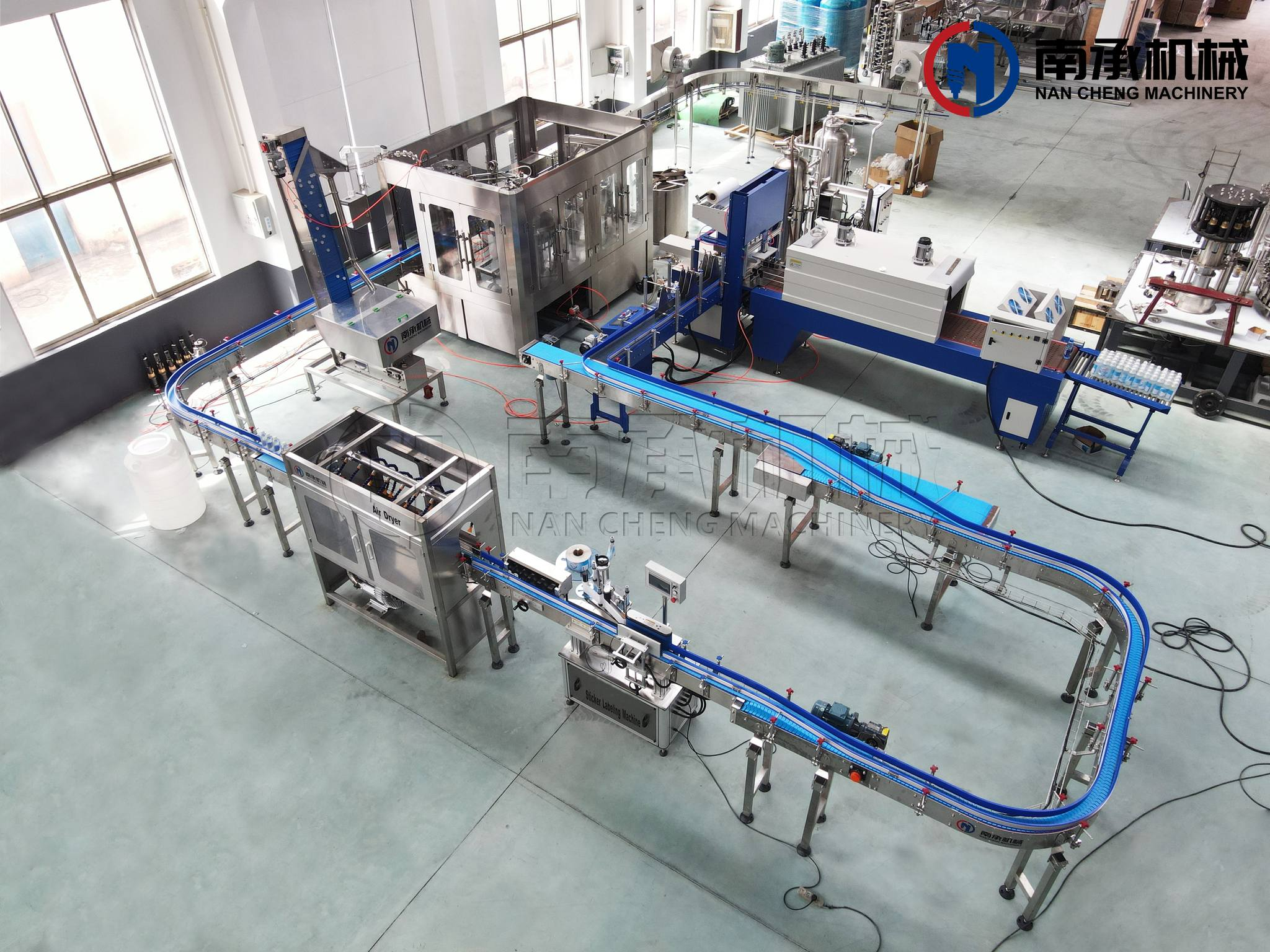
Complete Turnkey Beverage Production Lines
Nancheng Machinery provides complete beverage manufacturing solutions rather than only standalone filling equipment.
A typical carbonated beverage production line combines water treatment, syrup preparation, beverage mixing, carbonation, bottle blowing, filling, capping, labeling, and final packaging.
The company publishes equipment configurations covering approximately 3,000 to 18,000 BPH, depending on the selected filling machine model and bottle format.
For beverage producers planning 5,000 BPH or 10,000 BPH production facilities, the engineering team can prepare customized equipment configurations.
The complete system can also include automatic bottle conveying, inspection, date coding, shrink wrapping, and palletizing according to the project requirements.
Engineering and After-Sales Support
Establishing a beverage factory requires equipment integration and practical production planning.
Nancheng Machinery supports factory layout design, machinery selection, production line integration, electrical coordination, installation guidance, equipment commissioning, and operator training.
Its engineers can evaluate available utilities, including treated water, electricity, compressed air, CO₂ supply, and cooling requirements.
Before shipment, equipment testing can be arranged according to the agreed technical specifications.
For companies preparing a beverage factory project in Kazakhstan, Nancheng Machinery can provide a customized filling line proposal based on the product formulation, bottle dimensions, production capacity, and factory layout.
1. Nursapa
Nursapa supplies production machinery for liquid products in Kazakhstan. Its equipment catalog includes filling systems for drinking water, mineral water, beverages, and vegetable oil.
Published equipment options include mineral water bottling lines with reference capacities of 2,000 bottles per hour, 20-liter water filling equipment, and automatic or semi-automatic vegetable oil filling systems.
The company also provides equipment for smaller manufacturing businesses that require moderate production capacity.
For beverage entrepreneurs, Nursapa offers equipment sourcing options for bottle filling and liquid packaging applications.
Water bottling machines and edible oil filling machines use different dosing methods. Buyers should therefore confirm the filling principle and intended product compatibility before selecting equipment.
A factory planning carbonated beverages should also verify whether a dedicated counter-pressure filling machine is available.
3. PROSNAB Service
PROSNAB Service supplies bottling and manufacturing equipment in Kazakhstan, with a strong focus on drinking water production.
Its product range includes PET bottle blowing machines, bottle rinsing equipment, water filling systems, capping machinery, and supporting conveyors.
The company publishes automatic and semi-automatic configurations for different container sizes, including 0.5-liter bottles, 5-liter containers, and 19-liter water bottles.
Some product listings identify Kazakhstan as the country of manufacture, while others specify imported equipment.
For smaller bottled water businesses, PROSNAB Service provides compact filling solutions and supporting production equipment.
The company also offers equipment selection assistance and technical information covering machine installation and basic production requirements.
Buyers planning juice or carbonated soda production should confirm the relevant filling technology separately from standard water bottling configurations.
4. Emins LLP
Emins LLP operates in Kazakhstan and provides food and beverage production equipment.
Its website lists complete processing lines for juice and dairy products, including UHT milk, pasteurized milk, yogurt, and related beverage applications.
The company also offers aseptic carton filling equipment in different package volume ranges, including 100–330 mL and 500–1,000 mL configurations.
For juice manufacturers, a complete production system must coordinate ingredient preparation, thermal processing, hygienic transfer, filling, and packaging.
Emins provides equipment options for these operations through its processing and filling portfolio.
Aseptic carton filling differs from conventional PET bottle filling because packaging sterilization and hygienic product handling are central to the process.
For beverage companies planning juice or dairy-based drink production in Kazakhstan, Emins offers specialized production equipment and project solutions.
5. LinePAC LLP
LinePAC supplies and manufactures industrial filling equipment in Kazakhstan.
Its website lists automatic liquid filling lines, monoblock machines, triblock systems, mixing tanks, and PET bottle packaging equipment.
The company's published beverage production solutions include water treatment, syrup mixing, carbonation, bottle rinsing, filling, capping, labeling, and group packaging.
LinePAC also offers an LRG filling line designed for carbonated beverages, sparkling water, and still liquids packaged in PET bottles.
Another listed configuration is a 20/24/6 filling triblock with a reference capacity of 4,000 bottles per hour for 1.5-liter containers under specified conditions.
The company's equipment portfolio covers container volumes from small beverage bottles to larger PET formats.
For businesses planning soda or bottled water production, LinePAC provides machine configurations that can be evaluated according to production speed and packaging requirements.
6. Kazpump Flow LLP
Kazpump Flow is a Kazakhstan-based supplier specializing in equipment and technical services for beverage production.
Its website identifies water bottling lines, beverage filling equipment, packaging machinery, and related industrial components among its areas of activity.
The company also supplies spare parts, drive systems, pneumatic equipment, industrial automation components, flowmeters, and measurement technology.
Beyond equipment supply, Kazpump Flow offers production audits, modernization, relocation, commissioning, and maintenance services.
These services can be useful for established beverage factories planning to upgrade existing filling lines without replacing every machine.
For beverage manufacturers, compatibility between the filler, conveyors, controls, and downstream packaging systems is an important part of equipment modernization.
Kazpump Flow is best described as a beverage equipment supplier and engineering service provider rather than an independently verified filling machine manufacturer.
7. PAKKA Kazakhstan
PAKKA operates a Kazakhstan-facing equipment sales platform supplying liquid filling and packaging machinery.
Its catalog includes automatic carbonated beverage filling lines, lemonade bottling equipment, juice filling machines, water bottling lines, and filling monoblocks.
The company also lists equipment for large water containers and other liquid packaging applications.
One published carbonated beverage configuration covers a reference production range of approximately 1,000–3,000 bottles per hour, depending on machine selection.
PAKKA's systems can be configured with water preparation, cooling, carbonation, filling, capping, and packaging equipment.
Its product pages identify Russia as the manufacturing country and describe direct supply from the Russian production facility.
For beverage businesses in Kazakhstan, PAKKA provides a local sales channel for machinery manufactured outside the country.
8. Krones AG
Krones manufactures integrated processing and packaging equipment for beverage producers worldwide.
Its product portfolio covers beverage preparation, container manufacturing, filling, sealing, labeling, inspection, and downstream packaging.
For carbonated soft drinks, Krones supplies industrial filling systems designed around suitable product pressure and temperature conditions.
The company also provides packaging technologies for bottled water, juice, beer, and other beverages.
Complete line engineering connects individual machines to improve production coordination and maintain stable material flow.
9. KHS GmbH
KHS develops filling and packaging technology for water, carbonated soft drinks, beer, and other beverages.
Its equipment range includes filling systems for PET bottles, glass bottles, and aluminum cans.
For carbonated beverages, pressure-controlled filling helps manage foaming and carbonation retention.
KHS also manufactures machinery for container handling, sealing, inspection, labeling, and secondary packaging.
The company offers complete production line configurations for industrial beverage manufacturers with different output requirements.
10. Sidel
Sidel manufactures beverage filling and PET packaging machinery for global beverage producers.
Its systems connect bottle blowing, filling, capping, labeling, and secondary packaging operations.
Sidel also develops PET container designs for different beverage categories.
For carbonated drinks, container pressure resistance and filling conditions are important considerations.
The company offers complete PET bottling solutions for soft drinks, water, juice, and other ready-to-drink products.
11. SIPA
SIPA specializes in PET container manufacturing and beverage filling technology.
Its portfolio includes stretch blow molding, filling machinery, and complete bottling solutions.
The equipment can be configured for water, carbonated beverages, and other suitable liquid products.
PET bottle geometry and mechanical properties influence filling performance and package stability.
SIPA provides equipment configurations that coordinate bottle production with downstream filling and packaging.
12. SMI Group
SMI manufactures bottling and packaging equipment for still and carbonated beverages.
Its machinery portfolio includes bottle production, conveying, line integration, shrink wrapping, and palletizing.
The company supplies packaging technology for beverage manufacturers operating at different production capacities.
Conveyor synchronization and accumulation are important in maintaining the output of a complete filling line.
SMI develops systems that connect filling machines with secondary packaging equipment.
13. SACMI
SACMI manufactures beverage packaging equipment and container production technology.
Its product portfolio includes filling, capping, labeling, inspection, and related packaging systems.
The company develops solutions for different beverage types and container materials.
For carbonated soft drinks, stable filling pressure and suitable closure performance are important technical requirements.
SACMI also provides inspection technology that supports automated packaging quality control.
14. STM Pack
STM Pack designs and manufactures complete beverage bottling systems.
Its portfolio includes PET bottle blowing, filling, conveying, labeling, and downstream packaging equipment.
The company supplies solutions for still water, sparkling water, and carbonated soft drinks.
STM Pack has completed a bottling project in Karat, Kazakhstan, featuring production lines for sparkling and still water.
Published project information includes a 6,000 BPH line for 1.5-liter bottles, a 1,100 BPH line for 5-liter bottles, and equipment for 5-gallon containers.
This provides a documented example of an international filling equipment manufacturer supplying a complete beverage production project in Kazakhstan.
15. GEA Group
GEA manufactures industrial processing equipment used in beverage production.
Its technologies cover water deaeration, ingredient blending, carbonation, hygienic liquid processing, and automation.
For carbonated soft drinks, accurate mixing and CO₂ control help maintain consistent beverage formulation.
The preparation system must deliver a suitable product to the downstream filling machine.
GEA equipment can be integrated with compatible bottling systems for complete beverage production projects.
Comparison of Soft Drink Filling Machine Suppliers in Kazakhstan
The following table summarizes the 15 companies and their relevant equipment applications.
Company
Country / Market
Equipment Focus
Nancheng Machinery
China
Complete Beverage Filling Lines
Nursapa
Kazakhstan
Water and Liquid Filling Equipment
PROSNAB Service
Kazakhstan
Water Bottling Machinery
Emins LLP
Kazakhstan
Juice and Aseptic Filling
LinePAC LLP
Kazakhstan
Water and Carbonated Drink Filling
Kazpump Flow LLP
Kazakhstan
Bottling Equipment and Services
PAKKA Kazakhstan
Kazakhstan / Russia
Soda, Juice and Water Filling Lines
Krones
Germany
Turnkey Beverage Bottling
KHS
Germany
Carbonated Filling Systems
Sidel
France
PET Beverage Production
SIPA
Italy
PET Blowing and Filling
SMI Group
Italy
Bottling and Packaging
SACMI
Italy
Beverage Filling and Inspection
STM Pack
Poland
Complete Beverage Filling Lines
GEA
Germany
Beverage Mixing and Carbonation
The list includes manufacturers, local equipment suppliers, and engineering companies. Not all equipment is manufactured in Kazakhstan.
What Types of Soft Drink Filling Machines Are Available?
Soft drink filling equipment uses different operating principles depending on product characteristics.
Water, carbonated soda, juice, and other liquid products do not always require the same machine.
Filling Technology
Suitable Products
Main Requirement
Gravity / Atmospheric Filling
Still Water, Some Non-Carbonated Drinks
Stable Filling Flow
Isobaric Filling
Soda, Cola, Sparkling Water
Pressure and CO₂ Control
Hot Filling
Suitable Juice and Tea Products
Controlled Filling Temperature
Aseptic Filling
Juice and Sensitive Beverages
Sterile Processing Conditions
Volumetric Filling
Edible Oil, Syrups and Other Liquids
Accurate Volume Measurement
Flowmeter / Weight Filling
Oil and Suitable Liquid Products
Repeatable Dosing
For carbonated soft drinks, the equipment needs to maintain suitable pressure conditions to reduce CO₂ loss and foam formation.
For juice, filling temperature, product acidity, pulp content, and microbiological requirements are important factors.
Water bottling machines generally focus on hygienic handling, accurate filling, and reliable capping.
Some manufacturers also supply edible oil filling machinery, but these machines should not automatically be considered suitable for beverages.
Complete Soft Drink Production Line Equipment
A complete soft drink production line connects beverage preparation with filling and packaging.
For carbonated beverages, the process includes water treatment, ingredient mixing, cooling, carbonation, pressure filling, capping, and packaging.
For bottled water, the equipment configuration depends on source water quality and the treatment process.
Juice production may require additional heating, cooling, filtration, or aseptic processing equipment.
Production Stage
Equipment
Main Function
Water Treatment
Filtration / RO System
Prepares Process Water
Beverage Preparation
Syrup and Mixing Tanks
Controls Ingredients
Carbonation
Carbonator / Chiller
Controls CO₂ Concentration
Bottle Preparation
PET Blowing Machine
Manufactures Bottles
Filling
Beverage Filling Monoblock
Fills Containers
Capping
Automatic Capper
Applies Closures
Inspection
Fill-Level / Closure Inspection
Checks Packaging Quality
Packaging
Labeler / Shrink Wrapper
Prepares Finished Products
A production line should be designed around actual operating output rather than only the rated speed of the filling machine.
For example, a 10,000 BPH filling machine cannot maintain its nominal output if the downstream packaging equipment consistently operates at 7,000 BPH.
Machine synchronization and conveyor accumulation should be considered during production line planning.
How to Choose a Soft Drink Filling Machine Manufacturer in Kazakhstan
Selecting suitable equipment starts with identifying the actual product and production requirements.
Choose the Correct Filling Method
A carbonated beverage filling machine must support pressure-controlled filling.
Still water and selected non-carbonated beverages may use different filling principles.
For juice, the equipment must match product temperature, viscosity, pulp content, and hygiene requirements.
Ask the supplier to confirm product compatibility before selecting the filling machine.
Evaluate Production Capacity
Determine the number of bottles you need to produce each day.
A growing beverage business may choose a 3,000–5,000 BPH line, while larger factories may need 10,000 BPH or higher.
Actual output depends on packaging size, operating hours, product changeovers, and equipment efficiency.
Capacity should also match the available beverage preparation and packaging systems.
Check Container Compatibility
PET bottles, glass bottles, and aluminum cans require different handling and closure systems.
Even within PET packaging, different bottle sizes may need change parts or guide adjustments.
Confirm bottle dimensions, cap specifications, and future packaging requirements before manufacturing equipment.
Review Factory Layout and Utilities
A beverage factory needs reliable power, treated water, compressed air, and drainage.
Carbonated drinks also require CO₂ supply and cooling capacity.
The supplier should provide a practical equipment layout and utility requirements.
Allow sufficient space for machine maintenance, operator movement, raw materials, and finished products.
Confirm Equipment Origin and Technical Support
Kazakhstan-based equipment suppliers may sell machines manufactured locally or imported from other countries.
Confirm who manufactures the equipment, which components are included, and who provides warranty support.
For imported machinery, evaluate delivery terms, applicable conformity documentation, installation, commissioning, and spare parts availability.
A clear technical proposal helps prevent misunderstandings during project delivery.
Important Technologies in Modern Beverage Filling Lines
Isobaric Filling and CO₂ Control
Isobaric filling maintains suitable pressure conditions during carbonated beverage packaging.
This helps limit foam formation and unnecessary carbonation loss.
Correct product temperature, tank pressure, and filling valve settings are important for stable operation.
Automatic Controls and Production Monitoring
Modern filling machines often use PLC systems and touchscreen controls.
Operators can monitor production speed, machine status, alarms, and selected process parameters.
Automation supports repeatable operation and easier fault diagnosis.
CIP-compatible equipment allows cleaning solutions to circulate through tanks, pipelines, and filling circuits.
Cleaning parameters should match the actual beverage formulation and hygiene requirements.
Production Line Integration
Beverage preparation, filling, labeling, and packaging equipment must operate together.
Conveyor buffers, machine synchronization, and suitable line layouts help reduce production interruptions.
The final line design should account for expected production efficiency rather than relying only on nominal machine speed.
Suggested Image 3: Complete beverage filling production line with stainless steel equipment and conveyors.
ALT: Complete Soft Drink Filling and Packaging Production Line
Soft Drink Filling Machine Price in Kazakhstan
The price of a soft drink filling machine depends on production capacity, filling technology, automation level, and packaging requirements.
A compact water filling machine requires less equipment than a complete automatic beverage bottling line.
Carbonated soft drink systems need suitable carbonation and pressure filling technology.
Juice production may require additional processing, pasteurization, or aseptic filling equipment.
A turnkey project can also include water treatment, bottle blowing, conveyors, labeling, inspection, and final packaging.
For imported equipment, transportation, customs procedures, local installation, and spare parts should be included in the investment estimate.
Before comparing quotations, check whether the supplier is offering an individual machine or a complete production line.
A detailed quotation should identify the equipment configuration, production capacity, utility requirements, installation scope, and warranty terms.
Frequently Asked Questions
What Is a Soft Drink Filling Machine?
A soft drink filling machine transfers beverages into bottles or cans. The filling method depends on whether the product is still water, carbonated soda, juice, or another liquid beverage.
Are There Soft Drink Filling Equipment Suppliers in Kazakhstan?
Yes. Companies such as Nursapa, PROSNAB Service, Emins LLP, LinePAC, Kazpump Flow, and PAKKA Kazakhstan offer beverage filling equipment, related machinery, or engineering services in Kazakhstan.
Can One Filling Machine Handle Water, Juice and Soda?
Not necessarily. These beverages have different pressure, temperature, and hygiene requirements. The machine must be designed for the intended product or validated for multiple applications.
Which Filling Technology Is Used for Carbonated Soft Drinks?
Isobaric or counter-pressure filling is commonly used because it helps manage pressure during filling and reduce excessive foaming and CO₂ loss.
What Production Capacity Should a New Beverage Factory Choose?
Capacity depends on expected daily output, working hours, bottle sizes, equipment efficiency, and future production plans.
Can a Beverage Filling Machine Handle Different Bottle Sizes?
Yes, when designed for multiple formats. Change parts and mechanical adjustments may be necessary for different bottle dimensions or closures.
Do International Manufacturers Supply Equipment to Kazakhstan?
International manufacturers may supply complete bottling lines through export projects. Buyers should verify delivery terms, documentation, commissioning, and technical support arrangements.
How Much Does a Soft Drink Filling Machine Cost?
The price depends on filling technology, production capacity, container specifications, automation, and project scope. A customized quotation is needed for an accurate cost estimate.
Conclusion
Choosing a soft drink filling machine manufacturer is a critical decision when setting up a beverage production facility in Kazakhstan. Selected equipment must align with beverage category, targeted production capacity, packaging formats, on-site plant utility conditions, and long-term capacity expansion roadmaps.
Local Kazakhstan enterprises can support equipment procurement, production line integration, installation and after-sales technical services. Meanwhile, international machinery suppliers deliver broader portfolios of full beverage turnkey lines together with advanced specialized filling technologies, including isobaric filling for carbonated drinks, hot filling and aseptic cold filling for juice and still beverages.
For investors undertaking projects of bottled drinking water, carbonated soft drinks, fruit juice, dairy drinks and other liquid beverage production in Kazakhstan, Nancheng Machinery supplies tailor-made filling machinery and full turnkey beverage production line solutions. Our scope covers raw water treatment, beverage blending system, bottle blowing, filling-capping, labeling, end-of-line packaging, CIP cleaning system and on-site commissioning.
Please contact Nancheng Machinery to obtain a detailed quotation, customized equipment configuration sheet, complete technical datasheets, 2D/3D factory layout design proposal and project implementation schedule for your beverage manufacturing project in Kazakhstan.
 English
 العربية
 Français
 Русский
 Español
 Português
 Deutsch
 italiano
 Nederlands
 Tiếng Việt
 ไทย
 Polski
 Türkçe
 አማርኛ
 Bahasa Melayu
 Filipino
 Bahasa Indonesia
 magyar
 Română
 Čeština
 Монгол
 қазақ
 Српски
 हिन्दी
 فارسی
 Kiswahili
 Slovenčina
 Slovenščina
 Norsk
 Svenska
 українська
 Suomi
 Հայերեն
 Dansk
 اردو
 Shqip
 বাংলা
 Hrvatski
 Eesti keel
 සිංහල
 नेपाली
 Oʻzbekcha
 latviešu
 Azərbaycan dili
 Български
 ქართული
 Hausa
 Igbo
 Lietuvių
 Soomaali
 Yorùbá