English


Views: 0 Author: Site Editor Publish Time: 2026-05-07 Origin: Site


Bangladesh is becoming an increasingly attractive market for bottled water investment. With a large population, fast-growing urban consumption, rising awareness of drinking water safety, and strong demand from supermarkets, offices, schools, restaurants, hotels, and distributors, bottled water remains one of the most practical beverage businesses for new investors.
However, building a water bottling plant in Bangladesh is not only about buying a filling machine. A successful project requires proper market positioning, water source testing, treatment system design, bottle production planning, factory layout, power supply preparation, packaging selection, and long-term after-sales support.
This guide is written for entrepreneurs, investors, and companies planning to start or expand a bottled water business in Bangladesh in 2026. It explains the full process from idea to production and helps you avoid costly mistakes before purchasing equipment.
Bangladesh has several conditions that support bottled water demand. The country has a large and dense population, strong urban consumption in cities such as Dhaka, Chattogram, Sylhet, Khulna, Rajshahi, and Cox’s Bazar, and increasing demand for safe packaged drinking water in both retail and institutional channels.
For investors, bottled water is attractive because it is a repeat-purchase product. Once the brand gains distribution channels, demand can become stable. Customers may buy bottled water daily for homes, offices, events, shops, hospitals, schools, restaurants, and travel.
The market also has different entry levels. Some investors begin with 500ml and 1.5L PET bottles. Others build a complete water bottling plant with 5L, 10L, or 20L family packs. Larger investors may choose a high-capacity automatic water bottling line to supply regional distributors and supermarket chains.
The key is to choose the right capacity and configuration from the beginning. An under-designed plant may limit your growth, while an oversized plant may create pressure on cash flow, operators, and distribution.

Before purchasing land or machines, you should first understand your target market.
In Bangladesh, bottled water demand can be divided into several categories:
500ml bottles for retail shops, restaurants, events, hotels, and travel
1L and 1.5L bottles for daily drinking and family use
5L and 10L bottles for households and small offices
18.9L or 20L gallon bottles for offices, factories, and institutions
If your target customers are supermarkets and retail stores, PET bottles such as 500ml, 1L, and 1.5L are usually more suitable. If you want to supply offices and factories, 20L bottles may also be considered. If your target is regional distribution, a medium or high-capacity automatic PET bottled water line may offer better long-term competitiveness.
For a first-time investor, the recommended approach is usually to start with a clear product range instead of trying to produce every bottle size at the same time. For example, a 500ml and 1.5L PET bottled water line can cover a large part of retail demand. Later, you can add 5L or 20L production based on market feedback.
If you want to compare the best equipment brands and suppliers in the local market, you may also read our related guide: water bottling machine manufacturers in Bangladesh .
Every bottled water project must comply with local business, food safety, water quality, labeling, environmental, and tax requirements. Before ordering a complete line, investors should check the necessary approvals with local authorities, consultants, or experienced distributors in Bangladesh.
Typical preparations include:
Company registration
Factory license or trade license
Water source permission or supply agreement
Food safety approval
Water quality testing report
Product labeling requirements
Environmental and waste-water considerations
Tax and import documentation
This step is important because your factory layout, water treatment process, packaging design, and production environment may need to match local compliance standards. For example, the treatment room, filling area, bottle storage area, finished product warehouse, and washing area should be planned logically to avoid contamination and improve production efficiency.
A common mistake is buying machines first and only later checking whether the factory layout meets hygiene and production requirements. This often causes expensive changes during installation.
The water source determines the treatment system design. In Bangladesh, investors may consider municipal water, deep well water, surface water after proper treatment, or other approved sources. Each source has different risks and costs.
Before designing the system, you should test:
TDS
pH value
Hardness
Iron and manganese
Turbidity
Microbiological contamination
Heavy metals
Odor and color
Chlorine level if municipal water is used
For most bottled water plants, a full water analysis report is essential. Nancheng Machinery can review your raw water report and help design a suitable treatment process.
If the water has high hardness or high TDS, reverse osmosis may be required. If the water contains iron, manganese, or odor, pre-treatment must be strengthened. If the water source has microbiological risks, sterilization and hygienic design become even more important.

Water treatment is the heart of a bottled water plant. Even if the filling machine is fast and beautiful, the final product quality depends on the stability of the water treatment system.
A purified water treatment system include:
Raw water tank
Raw water pump
Quartz sand filter
Activated carbon filter
Water softener or anti-scalant dosing system
Precision filter
Reverse osmosis system
UV sterilizer
Ozone generator
Pure water storage tank
CIP or cleaning connections when required
For Bangladesh, the correct configuration depends heavily on the raw water quality. Some projects may only require standard pre-treatment and RO. Others may need additional iron removal, softening, or double-pass RO.
For bottled drinking water, ozone sterilization is commonly used before filling or in the pure water tank. Ozone helps maintain microbial control during storage and filling. UV sterilization can also be used before ozone injection or before final storage.
The water treatment system should not be designed only by capacity. It should be designed according to water quality, final product standard, production schedule, and storage time.

Choosing the right capacity is one of the most important investment decisions.
For new investors, common capacity options include:
2,000 BPH for small entry-level production
5,000–6,000 BPH for medium local distribution
8,000–12,000 BPH for stronger regional distribution
18,000–24,000 BPH for high-volume commercial production
36,000 BPH or above for large-scale brands
For Bangladesh, many investors should consider future growth carefully. If you already have strong distribution channels in Dhaka, Chattogram, or other major cities, a very small line may quickly become insufficient. On the other hand, if you are still testing the market, a medium-capacity automatic line may be safer than investing in a very large line immediately.
Nancheng Machinery can provide water bottling solutions from small and medium lines to high-capacity automatic production lines. For investors targeting long-term growth, we usually recommend leaving enough space in the factory layout for future expansion.
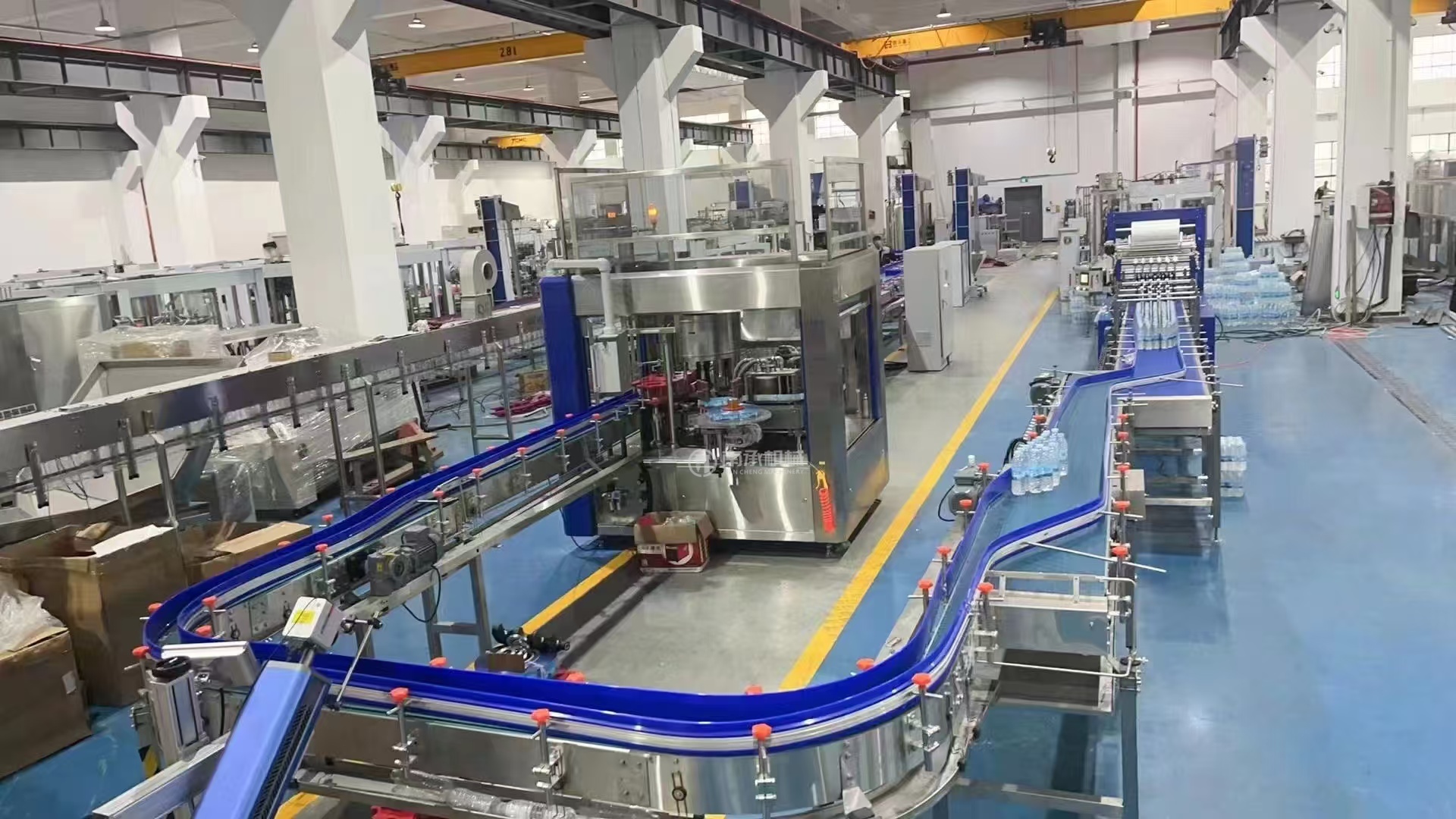
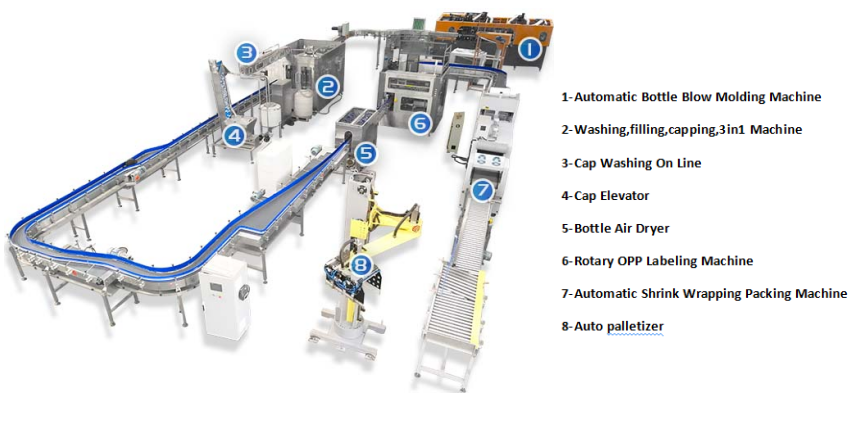
A complete PET bottled water production line includes:
Water treatment system
Bottle blowing machine
Air conveyor
3-in-1 rinsing, filling, and capping machine
Cap feeding system
Bottle dryer
Labeling machine
Date printer or laser coder
Shrink wrapping machine or carton packing machine
Conveyor system
Water treatment system
Air compressor system
Electrical control system
The 3-in-1 water filling machine is the core of the line. It combines bottle rinsing, water filling, and cap sealing in one monoblock. This design reduces contamination risk, saves space, and improves production efficiency.
If you are looking for a reliable water filling machine manufacturer , Nancheng Machinery can provide different models according to bottle size, capacity, automation level, and budget.
For a professional bottled water business, machine selection should not only focus on price. You should also check machine frame quality, stainless steel material, filling accuracy, capping stability, PLC control system, electrical components, after-sales service, and spare parts availability.

PET bottles can be produced in-house using a bottle blowing machine, or purchased from local bottle suppliers. Both options have advantages.
Buying bottles locally can reduce the initial investment. It is suitable for small production or market testing. However, it may increase long-term bottle cost and create supply risk if your volume grows.
Making bottles in-house requires investment in a bottle blowing machine, air compressor, molds, chiller, and preform handling. But it gives you better control over bottle design, cost, and supply stability.
For medium and large water bottling plants in Bangladesh, in-house bottle blowing is often more competitive in the long term. It allows you to customize bottle shape, reduce transportation of empty bottles, and improve brand identity.
If you plan to use several bottle sizes, such as 500ml, 1L, and 1.5L, you should confirm bottle mold requirements and changeover time before ordering equipment.
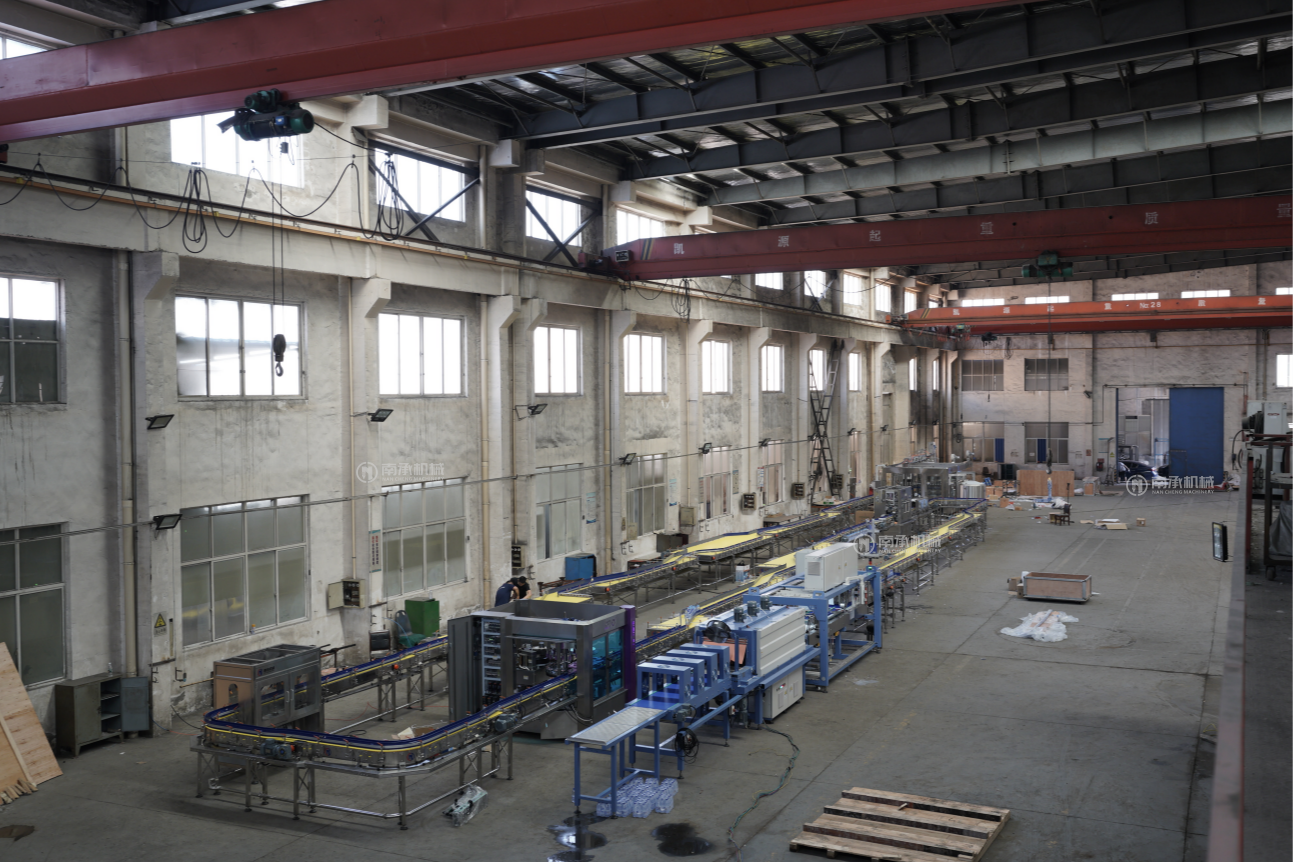
A good factory layout can reduce labor, improve hygiene, and make production smoother.
A typical water bottling plant should include:
Raw water treatment area
Pure water storage area
Bottle blowing area
Filling and capping area
Labeling and packing area
Finished goods warehouse
Raw material warehouse
Compressor room
Quality control room
Office and operator area
For Bangladesh, factory ventilation, temperature, humidity, dust control, drainage, and power stability should be considered carefully. The filling area should be kept clean and separated from dusty processes such as carton storage or external packaging.
The compressor room is usually better placed outside or in a separate room because compressors generate heat and noise. If the factory space is limited, the line layout should be designed before civil construction or renovation.
Nancheng Machinery can provide layout drawings according to your workshop dimensions, bottle sizes, capacity, and automation level.
The total cost of building a water bottling plant in Bangladesh depends on capacity, automation level, bottle size, water source, packaging type, and factory condition.
Main investment items include:
Land or factory rental
Factory construction or renovation
Water treatment system
Bottle blowing machine
Filling and capping machine
Labeling machine
Coding machine
Packing machine
Air compressor and auxiliary equipment
Installation and commissioning
Shipping, customs clearance, duties, and taxes
Raw materials such as preforms, caps, labels, film, and cartons
Working capital for labor, electricity, water, marketing, and distribution
As a general reference, a small automatic water bottling line may require a lower investment, while a high-capacity turnkey water bottling plant can require a much larger budget. Investors should not compare only machine prices. The real project cost includes utilities, workshop preparation, raw materials, import costs, and installation.
For a more detailed budget structure, you can read our related article: Water Bottling Plant Cost in Bangladesh - Full Investment & ROI Guide (2026 Guide) .
If you are searching for a water bottling plant for sale, Nancheng Machinery can provide a full quotation based on your target capacity, bottle size, water source, and factory layout.
Before equipment arrives, the factory must prepare utilities properly.
In Bangladesh, industrial power supply is commonly 380V, 50Hz, three-phase, while some auxiliary systems may use 220V single-phase. Before confirming equipment, investors should verify the actual local power condition and inform the machine supplier.
Important utility preparations include:
Stable three-phase electricity
Water supply for treatment system
Compressed air for bottle blowing and pneumatic components
Drainage system
Ventilation
Cooling water if required
Space for compressor and air tank
Grounding and electrical protection
High-capacity bottle blowing machines require stronger air compressor systems than filling machines. If the compressor is undersized, bottle quality and production stability will be affected.
For Bangladesh projects, voltage stability should also be considered. If the local power supply fluctuates, voltage stabilizers or proper electrical protection may be required.

Packaging has a direct impact on brand image and production cost.
Common labeling options include:
OPP hot melt labeling
Shrink sleeve labeling
Self-adhesive sticker labeling
For high-speed water lines, OPP labeling is often cost-effective because label material cost is relatively low and the machine can run at high speed. Shrink sleeve labeling gives a more colorful appearance but usually has higher material and energy costs. Sticker labeling is flexible but may be slower and more expensive for large-volume production.
Packing options include:
Shrink film packing
Carton packing
Tray shrink packing
Palletizing system
For Bangladesh retail channels, shrink film packing is commonly used for bottled water because it is economical and easy for distribution. Carton packing may be preferred for premium brands, export, or institutional customers.
Your packing style should be confirmed before layout design because packing equipment affects conveyor length, floor space, labor arrangement, and final product logistics.
A water bottling plant is a system project. Professional installation and commissioning are essential.
Nancheng Machinery can support investors with:
Equipment installation guidance
Line connection and adjustment
Operator training
Filling machine testing
Bottle blowing testing
Labeling and packing adjustment
Water treatment commissioning
Spare parts recommendation
Maintenance training
During commissioning, the supplier should test bottle feeding, rinsing, filling level, capping torque, label position, coding quality, packing stability, and line speed.
For new investors, training is especially important. Operators should understand daily cleaning, lubrication, fault diagnosis, bottle changeover, cap feeding, label replacement, and basic maintenance.
In bottled water production, brand trust depends on consistent quality.
A basic quality control plan should include:
Raw water testing
Treated water testing
Microbiological testing
Bottle inspection
Cap inspection
Filling level inspection
Ozone concentration control
Finished product sampling
Batch coding and traceability
Cleaning records
For Bangladesh, where consumers are increasingly concerned about safe drinking water, quality control can become a major selling point. A clean factory, stable product taste, attractive bottle design, and reliable distribution can help a new brand grow faster.
Investors should also prepare a professional brand strategy. Bottle shape, label design, carton design, and marketing message should be developed before production starts.
Nancheng Machinery is a professional manufacturer of water and beverage production equipment in China. We provide turnkey solutions for bottled water plants, carbonated beverage lines, juice production lines, 5-gallon water lines, bottle blowing systems, labeling machines, packing machines, and water treatment systems.
For Bangladesh investors, our advantage is not only supplying machines. We help customers plan the complete project from raw water to finished bottle.
Our services include:
Water treatment system design
Bottle and label design support
Production line layout
Capacity selection
Equipment manufacturing
Factory testing
Installation support
Operator training
After-sales service
Spare parts support
Whether you are building your first bottled water plant or expanding an existing production line, Nancheng Machinery can recommend a practical configuration based on your budget, market, bottle sizes, and future growth plan.

Building a water bottling plant in Bangladesh in 2026 can be a strong business opportunity, but success depends on proper planning. Investors should not rush to buy equipment before confirming the market, water source, capacity, factory layout, and total investment plan.
The best water bottling plant is not always the cheapest one. It is the system that matches your market, runs stably, meets quality standards, controls operating cost, and supports your brand growth for many years.
If you are planning to build a bottled water factory in Bangladesh, Nancheng Machinery can help you design a complete solution from water treatment to bottle filling, labeling, packing, installation, and training.
Contact Nancheng Machinery today to get a customized quotation, factory layout, and project proposal for your Bangladesh water bottling plant.


