You are here:Home » News » What Is a Mineral Water Filling Machine and How Does It Work?
What Is a Mineral Water Filling Machine and How Does It Work?
Views: 0 Author: Site Editor Publish Time: 2026-07-12 Origin: Site
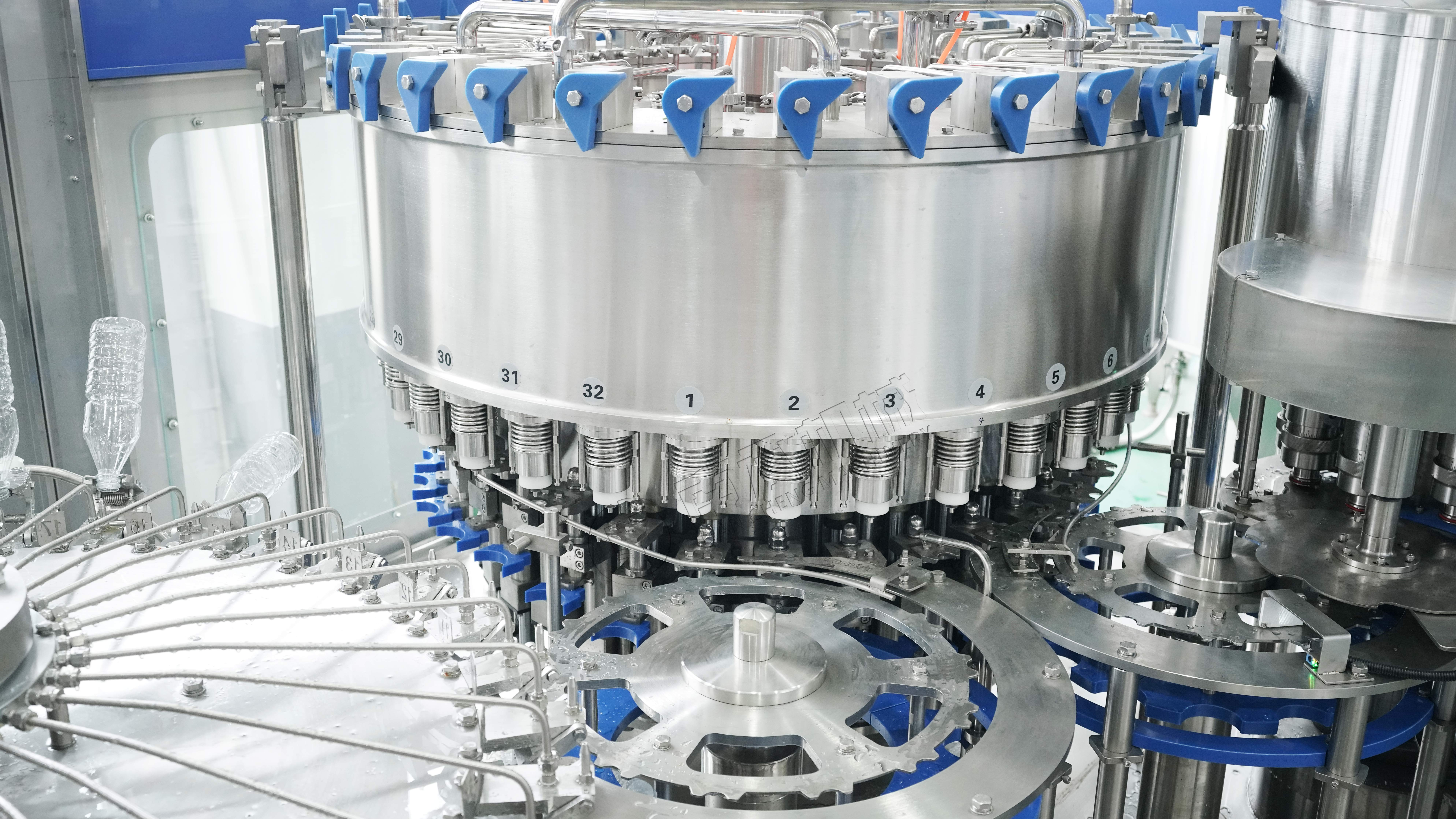
A mineral water filling machineis an automated system that rinses empty bottles, fills them with prepared mineral water, and seals them under hygienic conditions.
Most PET bottling plants use a 3-in-1 monoblock combining rinsing, filling, and capping. This reduces bottle transfers, saves floor space, limits contamination risk, and improves production stability.
A small line may use mechanical gravity valves, while a high-speed line may use electronic flow meters, non-contact filling, servo transfers, CIP, and production monitoring. This guide explains the main technologies, prices, and selection factors.
What Does a Mineral Water Filling Machine Do?
The machine transfers prepared water into clean bottles at a controlled liquid level or volume and immediately applies a cap.
A reliable filler should deliver stable bottle handling, accurate filling, low water loss, consistent cap torque, hygienic product contact, and smooth line synchronization.
The monoblock is normally the center of a line that may also include water treatment, bottle blowing, air conveying, labeling, coding, packaging, and palletizing. It should therefore be selected as part of the complete production system.
Mineral Water vs. Purified Water
Before selecting equipment, buyers must clearly define the product.
Natural Mineral Water
Natural mineral water normally comes from a protected underground source and has a relatively stable mineral composition.
Depending on local regulations, treatment options may be limited because the producer must preserve the water’s natural characteristics.
Purified Drinking Water
Purified water may come from groundwater, municipal water, or another approved source.
Its treatment process may include sand filtration, activated carbon, softening, precision filtration, ultrafiltration, reverse osmosis, UV, and ozone.
Should Mineral Water Always Use Reverse Osmosis?
No. Reverse osmosis removes dissolved salts, contaminants, and minerals. It is suitable for many purified-water projects but may be inappropriate when the goal is to preserve the original mineral profile.
Before designing the line, the supplier should review the source-water analysis, mineral composition, microbiological results, finished-water standard, local regulations, permitted treatment methods, capacity, and shelf-life target.
The treatment and filling system should match the actual water source instead of following one standard package for every project.
How Does a 3-in-1 Mineral Water Filling Machine Work?
A 3-in-1 monoblock uses synchronized rotary sections for rinsing, filling, and capping.
Bottles move through the machine using neck grippers, starwheels, guide plates, and controlled transmission systems.
Step 1: Empty Bottle Infeed
Empty PET bottles enter through an air conveyor.
Most modern lines support bottles by the neck ring rather than the base. Neck handling reduces bottle deformation, improves high-speed stability, and makes some format changes easier.
At the machine entrance, bottles are separated and transferred into the rinser at the correct spacing.
What Changes When Bottle Sizes Change?
Using the same neck finish simplifies changeover, but it does not mean that no mechanical parts must be replaced.
Bottles with the same neck finish may share neck grippers, rinsing clamps, caps, and some neck-handling parts. However, a 330 ml bottle and a 1.5 L bottle normally have different diameters, shoulders, heights, centers of gravity, and label areas.
The changeover may still require different starwheels and guide plates, conveyor-rail and height adjustment, sensor repositioning, and changes to the labeler or packaging machine.
A common neck finish reduces change parts, but bottle diameter, shape, and height still affect the complete line. The technical agreement should list all shared and replacement parts, included change-part sets, and the height-adjustment method.
Step 2: Bottle Rinsing
Inside the rinser, bottles are held by the neck, inverted, and positioned above rinsing nozzles.
The internal surface is flushed to remove dust and loose particles.
Suitable rinsing media may include:
Microbiologically controlled product water
Sterile filtered water
Ozonated water
Another validated medium permitted by local regulations
For disposable PET bottles produced in-house, controlled product water, sterile water, or ozonated water is generally the most practical choice.
Ozone and Bromate Control
Ozonated water is widely used because it provides microbiological control, but the process must be carefully managed.
Important controls include ozone concentration, contact time, rinsing duration, drainage, residual rinse water, ozone carryover, ventilation, and operator exposure.
After rinsing, bottles should remain inverted for a validated drainage period. This reduces rinse-water and ozone carryover into the filling section.
Bromate does not come from PET degradation. It may form when naturally occurring bromide ions in water are oxidized during ozonation.
Bromate control belongs mainly in water treatment and ozone dosing. Test source water for bromide, avoid excessive dosing, control pH and contact time, monitor residual ozone, and test the finished water. Bottle drainage limits ozone carryover but is not the main bromate control.
Step 3: Mineral Water Filling
Still mineral water is normally filled under atmospheric pressure.
Three terms are commonly used:
Mechanical gravity filling
Electronic flow-meter filling
Non-contact filling
These terms are related but do not describe the same principle.
Mechanical Gravity Filling
Mechanical gravity filling is a mature and economical solution for still mineral water and purified drinking water.
Water flows from the product tank into the bottle under gravity. The valve controls the final liquid level through its mechanical structure, bottle-mouth relationship, and air-return path.
Gravity filling is suitable for many small and medium bottling plants and can support outputs from about 1,000 to more than 12,000 BPH, depending on bottle size and machine configuration.
Limitations
Compared with electronic systems, a gravity filler provides less detailed volume monitoring, slower recipe adjustment, greater dependence on change parts, and less flexibility for complex bottle formats.
Gravity filling is not outdated. It remains a practical choice when the factory needs stable production without unnecessary electronic complexity.
Electronic Flow-Meter Filling
A flow-meter filling machine measures the amount of water delivered into each bottle.
When the programmed volume is reached, the electronic valve closes.
Advantages
Flow-meter filling improves volume control, reduces overfilling, speeds up recipe adjustment, supports production monitoring, and integrates well with high-speed lines.
Depending on the water conductivity and machine design, the system may use an inductive flow meter, mass flow meter, or another suitable measuring device.
Flow-meter filling costs more because each filling position may require an individual meter, electronic valve control, additional wiring, advanced PLC programming, calibration, and data communication.
The higher investment can be justified when precise volume control, traceability, and fast format changes are important.
How Does Non-Contact Filling Work?
Non-contact filling describes a hygienic valve arrangement in which the nozzle does not seal against or physically touch the bottle mouth.
It is not a separate measuring principle.
Because the valve cannot rely on a conventional bottle-mouth seal or return tube to determine the final level, the delivered quantity normally requires an independent measuring system, such as:
An inductive flow meter
A mass flow meter
A load-cell weighing system
Another validated electronic dosing method
A conventional mechanical gravity valve cannot simply be moved away from the bottle mouth and continue working with the same control logic.
The distinction is important:
Flow-meter filling describes how volume is measured.
Load-cell filling measures quantity by weight.
Non-contact filling describes how the valve interacts with the bottle.
Non-contact filling is therefore best understood as a hygienic filling architecture enabled by independent electronic metering.
It offers fewer contact points, easier cleaning, faster volume adjustment, and greater bottle-height flexibility, but requires more instrumentation, programming, calibration, and maintenance.
Step 4: Cap Feeding and Capping
After filling, bottles enter the capping section immediately.
Caps are supplied through a hopper, sorter, or automatic cap elevator. They are oriented and delivered through a cap chute.
Many machines use magnetic constant-torque capping heads. Higher-level systems may use electronic or servo-controlled cappers.
Correct torque is essential. A loose cap may leak, while excessive torque can damage the cap thread, bottle neck, or tamper-evident ring.
After capping, bottles move to inspection, labeling, coding, and packaging.
Main Components of a Mineral Water Filling Machine
A standard monoblock includes a bottle infeed, rotary rinser, product tank, filling valves, cap feeder, capper, starwheels, guide plates, PLC, HMI, and safety enclosure.
Product-contact parts are commonly made from SUS304 or SUS316 according to water chemistry, cleaning chemicals, and corrosion requirements. Starwheels and guide plates are customized for the intended bottle formats.
The control system manages machine speed, filling parameters, alarms, recipes, and connected conveyors. Transparent doors and electrical interlocks protect operators from moving parts.
Advantages of a 3-in-1 Monoblock
A monoblock lowers contamination risk, uses less floor space, stabilizes bottle transfer, simplifies operation, and reduces installation work. It can be integrated with bottle blowers, labelers, coders, wrappers, carton packers, and palletizers.
2026 Mineral Water Filling Machine Price Guide
The price depends on capacity, filling technology, number of valves, bottle range, material grade, electrical brands, automation level, hygiene design, CIP configuration, and line scope.
Production Level
Capacity
Estimated Budget
Typical Configuration
Entry Level
1,000–4,000 BPH
USD 12,000–28,000
Mechanical gravity filling, standard PLC, basic cap sorter, standalone monoblock
Growth Level
4,000–12,000 BPH
USD 30,000–90,000
More valves, improved hygiene, automatic cap elevator, optional electronic controls
Industrial Level
12,000–36,000+ BPH
USD 95,000–350,000+
High-speed gravity or flow-meter filling, advanced transfer, CIP provisions, line synchronization
These figures are for early budgeting only. They should not be treated as the price of a complete turnkey factory unless the quotation clearly includes all upstream and downstream equipment.
Why Can Two Machines With the Same Capacity Have Different Prices?
Two machines rated at 8,000 BPH may have very different configurations.
Price differences may come from:
Filling-valve technology
Number of filling positions
Stainless-steel grade
Electrical components
Cap feeding method
Hygiene design
Changeover system
CIP configuration
Factory testing
Spare-parts package
Buyers should compare technical configurations, not only rated speed and headline price.
Common Additional Costs
Water Treatment
A small treatment system may cost about USD 5,000–25,000. Larger UF, RO, UV, ozone, tank, and automation packages cost more.
Bottle Blowing, Packaging, and Installation
A complete project may also require a blow-molding machine, compressors, air treatment, chiller, molds, labeler, coder, shrink wrapper, carton packer, and palletizer.
International freight, duties, inland transport, engineer travel, visas, accommodation, lifting equipment, and local labor should be calculated separately.
Can One Machine Fill Still and Sparkling Mineral Water?
A conventional gravity filler cannot directly fill sparkling water.
Sparkling water requires isobaric or counter-pressure valves, a pressure-rated product tank, bottle pre-pressurization, low-turbulence filling, CO₂ control, controlled decompression, and pressure-rated piping.
Using a gravity filler for sparkling water would cause excessive foaming, CO₂ loss, unstable levels, and product waste.
A purpose-designed multipurpose pressure filler may handle both still and sparkling products, but this does not automatically make it the best investment.
Compared with a dedicated still-water filler, a multipurpose system may require more complex pressure circuits, gas systems, valve blocks, cleaning procedures, operator training, and maintenance.
Changing between still and sparkling products may involve product drainage, pipeline rinsing, CIP, gas purging, pressure stabilization, and recipe verification.
These steps can increase water use, chemical use, CO₂ consumption, startup loss, changeover time, and downtime.
A multipurpose filler is more reasonable when sparkling products represent a meaningful production share, product campaigns are long, the factory already has suitable CIP and CO₂ infrastructure, and the added flexibility justifies the higher cost.
For factories producing mainly still mineral water, a dedicated gravity or flow-meter filler is normally simpler and more economical.
How to Choose the Right Mineral Water Filling Machine
1. Calculate Real Capacity
Consider daily sales, shifts, bottle volume, line efficiency, seasonal demand, and future growth. Allow for cleaning, maintenance, format changes, and material loading.
2. Confirm Every Bottle Format
Provide bottle volume, height, body diameter, shoulder profile, neck finish, weight, cap type, and label area.
3. Share the Water Analysis
This helps determine whether the project needs filtration, softening, UF, RO, UV, ozone, or another treatment process.
4. Define the Complete Line Scope
Confirm whether the quotation includes water treatment, bottle blowing, compressors, filling, labeling, coding, packaging, conveyors, installation, training, and spare parts.
5. Request Real Production Videos
Ask for machines operating with similar bottles, speeds, and packaging formats.
6. Review the Component List
The quotation should clearly state the main brands, materials, valve technology, and technical specifications.
7. Compare Lifecycle Cost
Consider energy use, spare-parts availability, bottle damage, changeover time, cleaning requirements, technical support, and downtime risk.
The cheapest machine may not provide the lowest long-term cost.
Why Choose Zhangjiagang Nancheng Machinery?
Zhangjiagang Nancheng Machinery supplies mineral water filling machines and complete bottled-water production lines for startups, regional brands, and industrial plants.
Technology Matched to the Project
Available configurations include mechanical gravity, hygienic gravity, electronic flow-meter, non-contact, isobaric, and complete turnkey systems.
The recommended solution is based on the product, capacity, bottle format, hygiene requirements, factory conditions, and budget.
Complete Turnkey Integration
Nancheng Machinery can integrate water treatment, bottle blowing, air conveying, filling, capping, labeling, coding, packaging, factory layout, installation, and operator training.
Food-Grade Materials
Product-contact parts can be manufactured from SUS304 or SUS316 according to water chemistry and project requirements.
Configurable Components
PLC, inverter, motor, sensor, and pneumatic brands can be selected according to customer preferences and local spare-parts availability.
In-House Line Testing
Major equipment sections can be connected and tested before shipment to verify bottle transfer, filling accuracy, cap feeding, conveyor synchronization, label positioning, and packaging compatibility.
Frequently Asked Questions
What Is the Difference Between a Water Filler and a Mineral Water Filler?
The filling principle may be similar. The main differences are usually the water treatment process, sanitation requirements, product standards, and complete line design.
Can One Machine Fill 330 ml, 500 ml, and 1.5 L Bottles?
Yes, but the same neck finish does not mean that no change parts are required. Differences in bottle diameter, shape, and height may require new starwheels, guide plates, rail adjustments, and downstream settings.
Can a Gravity Filler Fill Sparkling Water?
No. Sparkling water requires an isobaric or counter-pressure filling system.
Should I Choose SUS304 or SUS316?
SUS304 is suitable for many standard applications. SUS316 provides stronger corrosion resistance for certain water compositions or sanitation requirements.
What Maintenance Is Required?
Routine maintenance includes cleaning tanks and pipelines, inspecting valve seals, checking bottle grippers, testing cap torque, lubricating specified parts, cleaning sensors, checking air pressure, and replacing worn O-rings.
What Information Is Needed for a Quotation?
Provide the required capacity, bottle drawings, cap and neck type, water analysis, label format, packaging method, factory voltage, available space, destination port, and installation requirements.
Mechanical gravity filling remains economical for many small and medium still-water projects. Flow-meter and non-contact systems suit higher-speed or higher-specification lines.
Compare suppliers by filling technology, valve design, changeover requirements, materials, components, CIP, testing, support, and lifecycle cost—not capacity and price alone.
Zhangjiagang Nancheng Machinery provides customized mineral water filling machines and turnkey bottling lines covering water treatment, bottle blowing, filling, labeling, coding, and packaging.
For an accurate proposal, provide your required capacity, bottle sizes, water analysis, factory layout, and packaging format.
 English
 العربية
 Français
 Русский
 Español
 Português
 Deutsch
 italiano
 Nederlands
 Tiếng Việt
 ไทย
ไทย Polski
 Türkçe
 አማርኛ
አማርኛ Bahasa Melayu
 Filipino
 Bahasa Indonesia
 magyar
 Română
 Čeština
 Монгол
 қазақ
қазақ Српски
 हिन्दी
 فارسی
فارسی Kiswahili
 Slovenčina
 Slovenščina
 Norsk
Norsk Svenska
 українська
 Suomi
Suomi Հայերեն
 Dansk
Dansk اردو
اردو Shqip
Shqip বাংলা
বাংলা Hrvatski
 Eesti keel
 සිංහල
සිංහල नेपाली
 Oʻzbekcha
 latviešu
 Azərbaycan dili
 Български
 ქართული
 Hausa
Hausa Igbo
Igbo Lietuvių
 Soomaali
 Yorùbá