The DXGF40-40-12 Semi-Electronic Valve Carbonated Beverage Filling Machine is designed for automatic PET bottle filling of carbonated soft drinks, sparkling water, soda, cola, and other carbonated beverages.
The machine integrates 40 bottle rinsing stations, 40 semi-electronic filling valves, and 12 capping heads into one automatic rotary system. It combines isobaric filling technology with PLC-controlled valve operation to improve filling consistency, pressure management, and production stability.
Compared with conventional mechanical filling valves, the semi-electronic valve configuration provides more flexible control of filling sequences and valve actuation. This helps reduce unnecessary foaming, maintain carbonation, and improve repeatability during continuous production.
With a reference production capacity of 15,000–18,000 bottles per hour, depending on bottle size and operating conditions, the DXGF40-40-12 is suitable for medium-to-large carbonated beverage manufacturing plants.
Advanced Semi-Electronic Valve Carbonated Filling Technology
The DXGF40-40-12 combines automatic valve actuation with isobaric filling technology for carbonated beverages.
During the filling process, the machine manages CO₂ pressure equalization, beverage filling, and controlled pressure release. Pneumatically actuated filling valves respond to PLC control signals, allowing the system to coordinate valve operations during continuous production.
This configuration provides more flexible control over filling timing than a purely mechanical valve system.
The actual filling performance depends on valve design, pressure stability, beverage temperature, carbonation level, and machine settings.
Four Key Advantages
✔ Semi-Electronic Valve Control
PLC-controlled pneumatic valve actuation supports responsive filling operations, consistent valve timing, and stable performance during high-speed carbonated beverage production.
✔ Stable Carbonation Retention
Isobaric filling maintains suitable pressure conditions during beverage transfer, helping reduce excessive foaming and unnecessary CO₂ loss.
✔ Integrated 40-40-12 Monoblock Design
The machine combines 40 rinsing stations, 40 filling valves, and 12 capping heads in one synchronized rotary system, reducing container transfers between separate machines.
✔ High-Capacity Automatic Production
Designed for continuous PET beverage bottling, with a reference capacity of 15,000–18,000 BPH and integration options for automatic labeling, inspection, and packaging.
How Does the DXGF40-40-12 Filling Machine Work?
The DXGF40-40-12 operates through three coordinated sections: bottle rinsing, counter-pressure filling, and automatic capping.
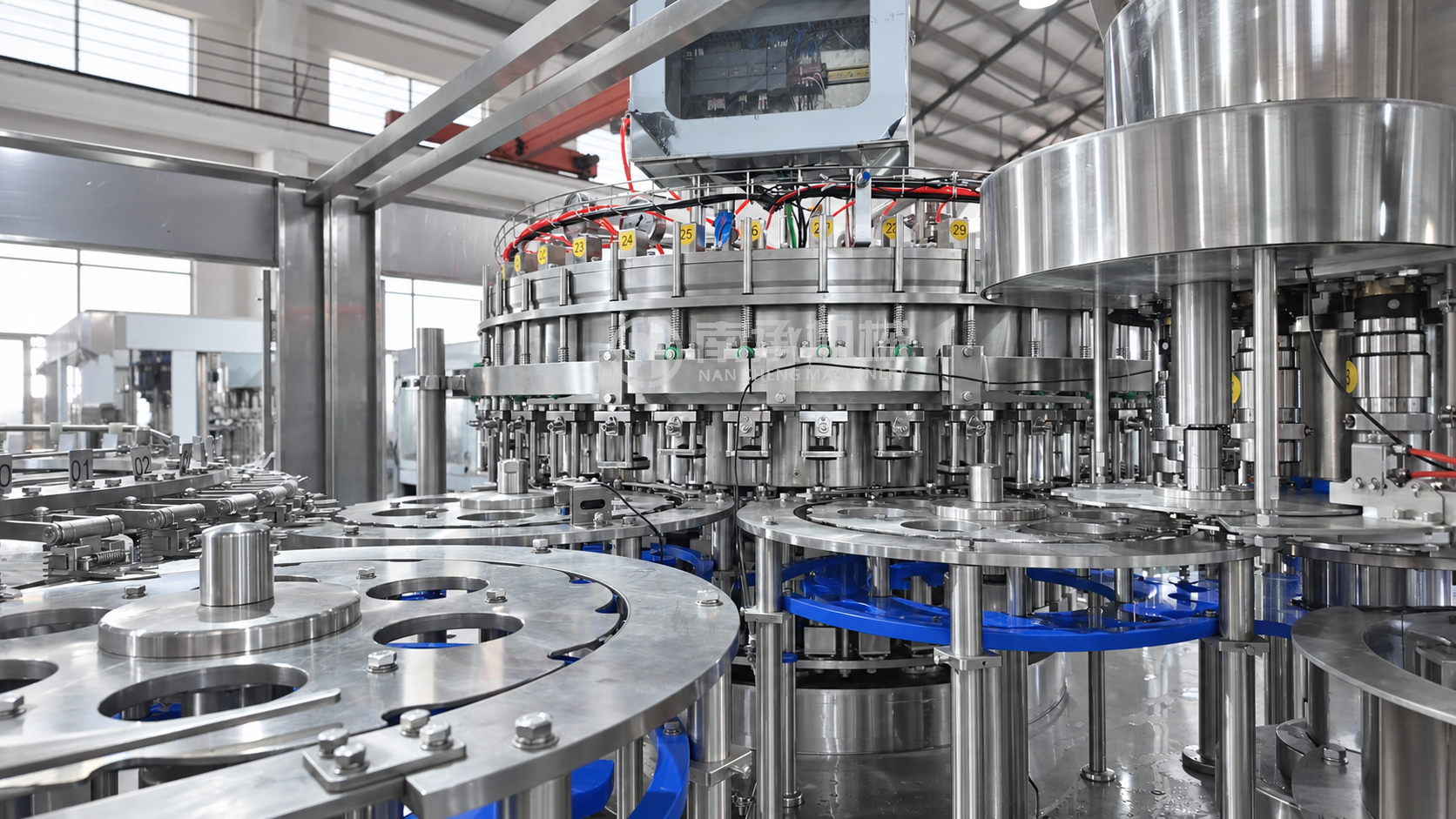
Bottle Rinsing
Empty PET bottles enter the machine through the infeed conveyor and bottle-handling system.
The 40-station rinsing section positions and rinses the bottles before transferring them to the filling carousel.
The rinsing configuration can be selected according to the required hygiene standard and production conditions.
CO₂ Pressure Equalization
After the rinsing stage, bottles are transferred to the filling section.
Each bottle is positioned against a filling valve. The filling system introduces CO₂ to establish suitable internal pressure before beverage filling begins.
This pressure equalization process reduces sudden CO₂ breakout when the carbonated beverage enters the bottle.
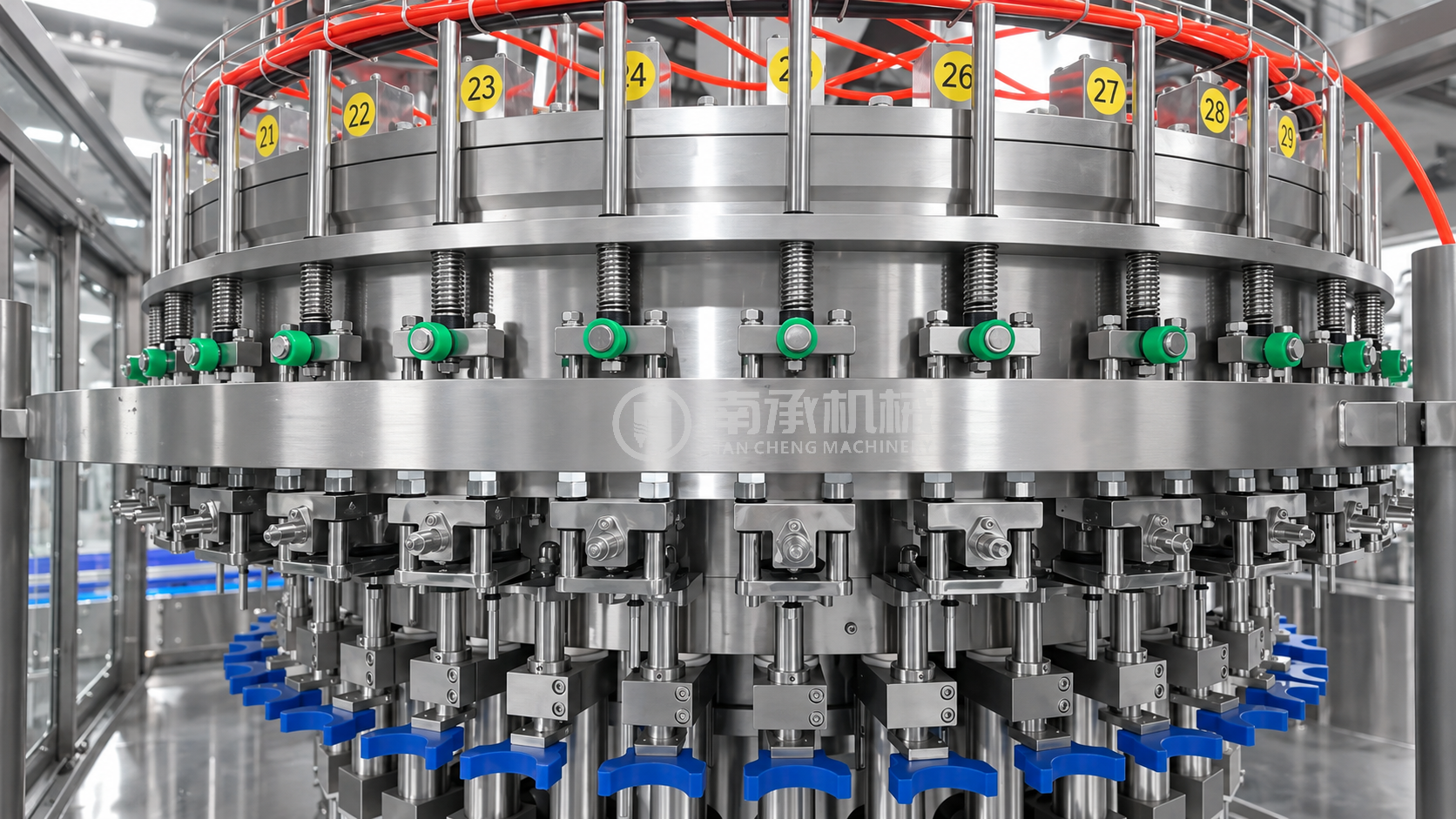
Semi-Electronic Valve Filling
The PLC coordinates valve actuation during the filling cycle.
Compressed air operates the pneumatic valve components, while control signals manage the required filling sequence.
The carbonated beverage enters under controlled pressure conditions.
After reaching the required filling level, the machine completes the filling process and performs controlled pressure release.
This helps limit foam overflow before the bottle reaches the capping station.
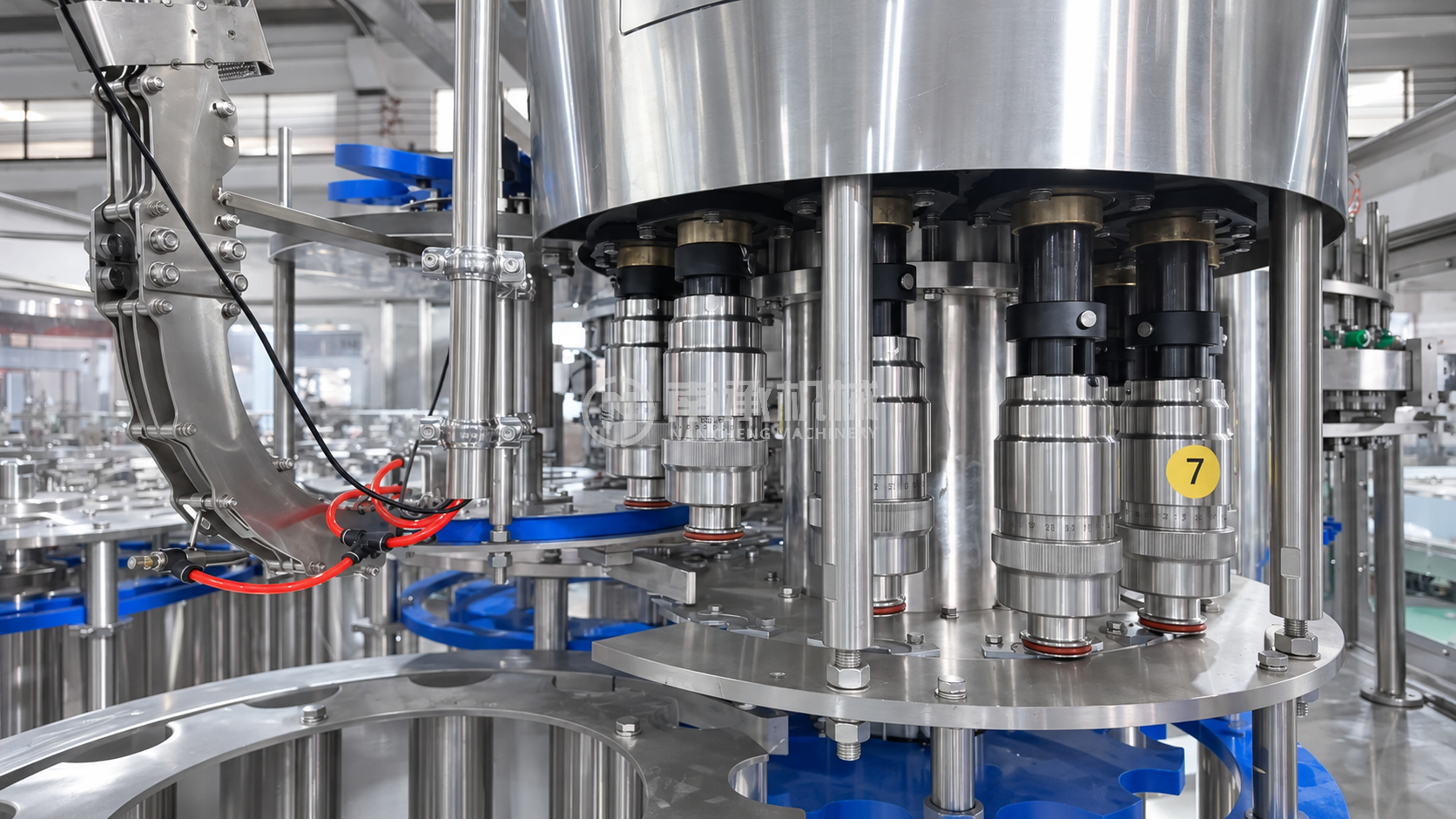
Automatic Bottle Capping
The filled bottles enter the 12-head capping section.
The automatic cap feeding and capping system applies compatible plastic screw caps to the bottles.
The synchronized transfer arrangement minimizes delays between filling and sealing.
After capping, the bottles leave the machine through the discharge conveyor and continue to downstream inspection, labeling, and packaging.
DXGF40-40-12 Technical Specifications
The following specifications are based on Nancheng Machinery's published DXGF40-40-12 reference configuration. Final machine parameters should be confirmed for the semi-electronic valve version.
| Technical Parameter | Specification |
| Machine Model | DXGF40-40-12 |
| Machine Type | Automatic Rinsing, Filling and Capping Monoblock |
| Filling Valve Type | Semi-Electronic Isobaric Valve |
| Rinsing Stations | 40 |
| Filling Valves | 40 |
| Capping Heads | 12 |
| Reference Capacity | 15,000–18,000 BPH |
| Filling Product | Carbonated Soft Drinks |
| Filling Principle | Isobaric / Counter-Pressure |
| Container Type | PET Bottles |
| Reference Bottle Volume | 200–2,000 mL |
| Reference Bottle Diameter | 50–115 mm |
| Reference Bottle Height | 160–330 mm |
| Cap Type | Plastic Screw Cap |
| Main Frame Material | SUS304 Stainless Steel |
| Product-Contact Parts | SUS304 / SUS316L Options |
| Control System | PLC + HMI |
| Valve Actuation | Pneumatic Actuation with PLC Control |
| Compressed Air Pressure | 0.3–0.7 MPa Reference |
| Electrical Supply | Customized for Project Location |
| Machine Dimensions | Reference: 4,500 × 3,300 × 2,600 mm |
| Cleaning | CIP-Compatible Filling Circuit |
Technical Note: Rated capacity, installed power, equipment weight, valve construction, and exact filling performance must be confirmed against the final DXGF40-40-12 semi-electronic valve engineering specification.
Semi-Electronic Valve vs. Mechanical Filling Valve
The filling valve plays an important role in carbonated beverage production because it controls the product transfer process and affects filling stability.
Traditional mechanical isobaric valves generally rely on mechanical actuation sequences, while semi-electronic valves use electronic control signals together with pneumatic components.
| Feature | Mechanical Filling Valve | Semi-Electronic Filling Valve |
| Valve Actuation | Mechanical Control | PLC-Controlled Pneumatic Actuation |
| Filling Sequence | Mainly Mechanical | Electronically Coordinated |
| Timing Adjustment | Mechanical Adjustment | Control-Parameter Adjustment |
| Operating Flexibility | Standard | Greater Control Flexibility |
| Control Integration | Basic | PLC-Based |
| Maintenance Focus | Mechanical Components | Pneumatic and Control Components |
| Typical Application | Standard CSD Filling | Automated CSD Production |
A semi-electronic valve should not be confused with a fully electronic flowmeter filling valve.
The term semi-electronic refers to electronic control of selected filling operations. It does not automatically mean that each filling valve uses an electronic flowmeter for volumetric measurement.
Suitable Carbonated Beverage Applications
The DXGF40-40-12 carbonated beverage filling machine is designed for suitable carbonated drinks packaged in pressure-resistant PET bottles.
Carbonated Soft Drinks
Suitable for cola, lemon-lime soda, flavored carbonated drinks, and other conventional carbonated soft drink formulations.
Sparkling Water
Supports pressure-controlled filling of sparkling water and flavored sparkling water, subject to the required carbonation and filling conditions.
Carbonated Energy Drinks
Can be evaluated for carbonated energy drink formulations after confirming beverage characteristics, filling temperature, foam behavior, and required hygiene conditions.
Other Carbonated Beverages
Additional carbonated products can be evaluated according to viscosity, acidity, ingredients, CO₂ content, and compatibility with the filling system.
Main Machine Components and Features
Stainless Steel Machine Structure
The machine uses a stainless steel enclosure with transparent protective doors, providing access for inspection and routine maintenance.
Product-contact materials can be selected according to beverage characteristics and hygiene requirements.
Automatic PLC Control System
The PLC coordinates the rinsing, filling, capping, and machine protection sequences.
The HMI allows operators to monitor equipment status, change selected operating settings, and review alarms.
Bottle Handling and Transfer System
The rotary bottle handling system synchronizes container movement through the washing, filling, and capping sections.
Guide rails and change parts are selected according to actual bottle dimensions.
Automatic Cap Feeding and Capping
The capping system feeds, positions, and applies suitable screw caps to the filled PET bottles.
Cap specifications and application torque should be matched to the bottle neck and closure design.
CIP-Compatible Filling Circuit
The filling circuit can be configured for Clean-in-Place procedures, allowing cleaning solutions to circulate through compatible beverage-contact components.
Cleaning parameters should follow validated plant hygiene procedures.
COMPLETE LINE SOLUTION WITH CARBONATED DRINK FILLING LINE

Nancheng Machinery provides complete carbonated drink filling line solutions for cola, soda, sparkling water, carbonated energy drinks, and other carbonated beverages. Each production line integrates water treatment, syrup preparation, carbonation, PET bottle blowing, isobaric filling, labeling, and packaging into a coordinated manufacturing system.
Our carbonated beverage production line can be customized according to production capacity, bottle size, CO₂ content, factory layout, and automation requirements. From individual machines to complete turnkey projects, we provide equipment integration, installation guidance, commissioning, and technical support.
Water Treatment System
Water quality plays an important role in the taste, consistency, and stability of carbonated beverages. Our water treatment system can combine quartz sand filtration, activated carbon filtration, water softening, reverse osmosis (RO), and UV disinfection to prepare water suitable for beverage production.
The treatment configuration is designed according to raw water quality and the required product specifications. Automated monitoring helps maintain stable water treatment performance and provides a reliable water supply for syrup preparation and beverage mixing.
Syrup Preparation and Mixing System
The syrup preparation system ensures accurate ingredient mixing and consistent beverage formulation. Sugar is dissolved and filtered before being transferred to sanitary mixing tanks, where it is combined with flavor concentrates and other ingredients.
Stainless steel tanks, sanitary pumps, and automated dosing controls help maintain consistent mixing ratios. The system can also incorporate CIP cleaning to support hygienic production and efficient recipe changeovers.
Prepared syrup is transferred to the beverage blending system for proportioning with treated water before carbonation.
Carbonation and Chilling System
The carbonation and chilling system controls beverage temperature, CO₂ concentration, and mixing conditions before filling.
A beverage chiller typically reduces the product temperature to approximately 2–4°C, depending on the formulation and carbonation requirements. Lower temperatures improve CO₂ solubility and help maintain stable carbonation during production.
The carbonation system mixes treated water and syrup at the required ratio before introducing food-grade CO₂ under controlled pressure. PLC automation monitors temperature, pressure, and flow to maintain consistent beverage quality.
PET Bottle Blowing Machine
The automatic PET bottle blowing machine produces pressure-resistant bottles suitable for carbonated soft drinks and sparkling water.
PET preforms are heated and stretch-blown into the required bottle shape using compressed air and precision molds. Bottle design, material distribution, and pressure resistance are selected according to the product's carbonation level and packaging requirements.
The bottle blowing system can be connected to the carbonated drink filling machine through an automatic air conveyor, reducing manual bottle handling and supporting continuous production.
Rinsing, Filling and Capping Machine
The automatic 3-in-1 rinsing, filling, and capping machine is the core equipment of the carbonated drink filling line. It combines three operations into one synchronized rotary system to reduce bottle transfers and maintain stable production.
The rinsing section cleans empty PET bottles before filling. The isobaric filling system equalizes pressure between the beverage tank and bottles, allowing carbonated drinks to enter under controlled conditions with reduced foaming and CO₂ loss.
After filling, the automatic capping system applies plastic screw caps with controlled torque to maintain reliable sealing performance.
The machine features a stainless steel structure, PLC control, automatic fault detection, and CIP-compatible product circuits. SUS304 and optional SUS316L materials can be used according to product-contact requirements.
Labeling and Date Coding System
The labeling system provides flexible decoration options for different PET bottle shapes, sizes, and packaging designs.
Depending on production requirements, the line can be equipped with PVC or PET shrink sleeve labeling, OPP hot melt labeling, or self-adhesive labeling machines. Automatic positioning and synchronized conveyor control support consistent label application during continuous operation.
An integrated inkjet printer or laser coding system marks production dates, batch numbers, and other required product information to support traceability.
Secondary Packaging System
After labeling and inspection, finished bottles enter the secondary packaging section for automatic grouping and packing.
The carbonated beverage production line can be equipped with PE film shrink wrapping machines, carton packing machines, or other packaging systems according to market requirements.
Shrink packaging can group bottles into packs of 6, 12, or 24, depending on bottle dimensions and packaging design. Carton packaging provides additional protection during storage and transportation.
Automatic packaging equipment reduces manual handling and helps maintain continuous production from filling to finished products.
Conveyor and Automation Control System
The conveyor system connects the main equipment into a complete automatic carbonated drink filling line, maintaining coordinated bottle movement throughout production.
Air conveyors transfer empty PET bottles from the blowing machine to the filling section, while stainless steel chain conveyors transport filled bottles through labeling, inspection, and packaging.
PLC control systems and touchscreen HMIs allow operators to monitor machine status, production speed, alarms, and relevant operating parameters. Siemens or other industrial control components can be configured according to project requirements.
Conveyor speed control, bottle accumulation, and automatic machine interlocks help reduce unnecessary line stoppages and improve overall production efficiency.
PET Bottle Blow Molding Machine


Semi automatic blow molding machine for you choose
Water Treatment System

Automatic Shrink Sleeve Labeling Machine

Bottle Shrink Packing Wrapping Machine

 English
 العربية
 Français
 Русский
 Español
 Português
 Deutsch
 italiano
 Nederlands
 Tiếng Việt
 ไทย
 Polski
 Türkçe
 አማርኛ
 Bahasa Melayu
 Filipino
 Bahasa Indonesia
 magyar
 Română
 Čeština
 Монгол
 қазақ
 Српски
 हिन्दी
 فارسی
 Kiswahili
 Slovenčina
 Slovenščina
 Norsk
 Svenska
 українська
 Suomi
 Հայերեն
 Dansk
 اردو
 Shqip
 বাংলা
 Hrvatski
 Eesti keel
 සිංහල
 नेपाली
 Oʻzbekcha
 latviešu
 Azərbaycan dili
 Български
 ქართული
 Hausa
 Igbo
 Lietuvių
 Soomaali
 Yorùbá


