You are here:Home » News » Water Bottling Line Cost in Brazil: Full Investment & ROI Guide (2026)
Water Bottling Line Cost in Brazil: Full Investment & ROI Guide (2026)
Views: 0 Author: Site Editor Publish Time: 2026-05-22 Origin: Site
Brazil is one of the most attractive bottled water markets in Latin America. With a population exceeding 215 million people, a tropical climate, rising health awareness, and increasing concerns about drinking water quality, the demand for bottled water continues to grow steadily across the country.
For entrepreneurs and investors planning to enter the Brazilian beverage industry, one question always comes first:
How much does it really cost to build a water bottling line in Brazil in 2026?
The answer depends on multiple factors, including production capacity, bottle types, automation level, water treatment configuration, packaging method, factory infrastructure, import taxes, electricity consumption, and logistics.
Unlike many smaller markets, Brazil has unique investment challenges. Investors must consider local taxes, customs clearance, interstate logistics, industrial electricity costs, and ANVISA sanitary requirements before starting a project.
This comprehensive guide explains the real investment cost of building a water bottling plant in Brazil, including machinery pricing, hidden infrastructure costs, monthly operating expenses, and ROI analysis.
If you are still researching suppliers and factory planning, you can also read our related guides:
Why Brazil Is a Strong Market for Bottled Water Investment
Brazil has one of the largest beverage consumption markets in the world. Rising urbanization, increasing middle-class consumption, and growing health-conscious lifestyles continue to push bottled water demand upward.
Several factors make Brazil especially attractive for bottled water investment:
Hot tropical climate throughout much of the country
Growing tourism and hospitality industry
Expansion of supermarkets and convenience stores
Increasing demand for purified drinking water
Strong 20L gallon water delivery market
Large regional distribution opportunities
Unlike smaller Latin American countries, Brazil’s massive geographic size creates localized demand centers. Transportation costs between states can be very high, making regional water bottling factories highly competitive.
This is why many investors focus on:
Regional bottled water brands
20L gallon water distribution
Medium-scale PET bottle production
OEM/private label water supply
Main Factors That Affect Water Bottling Plant Cost in Brazil
There is no single fixed investment cost for a bottled water factory. Final investment depends on several key factors.
Production Capacity (BPH)
Production speed is measured in BPH (Bottles Per Hour), usually based on 500ml PET bottles.
Higher production capacity requires:
Larger filling machines
More powerful air compressors
Bigger blow molding systems
Larger electrical infrastructure
More automated packaging systems
This directly affects overall investment.
Water Bottling Line Cost by Capacity in Brazil
Production Capacity
Estimated Equipment Investment
Suitable Market
Automation Level
1,000–2,000 BPH
USD 40,000–80,000
Small local towns / 20L gallon business
Semi-automatic
3,000–6,000 BPH
USD 120,000–300,000
Regional water brands
Fully automatic
8,000–12,000 BPH
USD 300,000–650,000
Commercial factories
Rotary monoblock
18,000–24,000+ BPH
USD 800,000–1.5M+
Large industrial production
High-speed combiblock
These prices are reference ranges only. Final pricing depends on machine configuration, bottle sizes, labeling systems, packaging type, automation level, and local installation requirements.
Brazil commonly uses industrial voltage systems such as 220V, 380V, and 440V at 60Hz, so electrical specifications should always be confirmed before manufacturing equipment.
Water Treatment System Cost
The water treatment system is one of the most important investments in a bottled water project. The final configuration depends on the quality of the raw water source.
Water analysis should include:
TDS level
Hardness
Heavy metals
Microbiological safety
Mineral composition
pH level
A typical bottled water treatment process in Brazil may include:
Raw Water Tank → Quartz Sand Filter → Activated Carbon Filter → Water Softener → RO System → UV Sterilizer → Ozone Generator → Finished Water Tank
Water Treatment System Cost Reference
Water Treatment System
Estimated Cost
Basic filtration system
USD 6,000–40,000
RO water treatment system
USD 15,000–60,000
Large industrial RO system
USD 80,000+
For most urban bottled water projects in Brazil, RO + UV + ozone sterilization systems are commonly recommended to meet sanitary standards.
PET Bottle Blowing Machine Cost
Most bottled water factories in Brazil use PET bottles. Bottle blowing machines convert PET preforms into finished bottles using compressed air.
Electricity consumption is especially important in Brazil. High-pressure air compressors consume significant power during bottle blowing.
Nancheng Machinery can provide air recycling systems for bottle blowing machines, helping reduce compressed air consumption and lower long-term electricity costs.
Water Filling Machine Cost
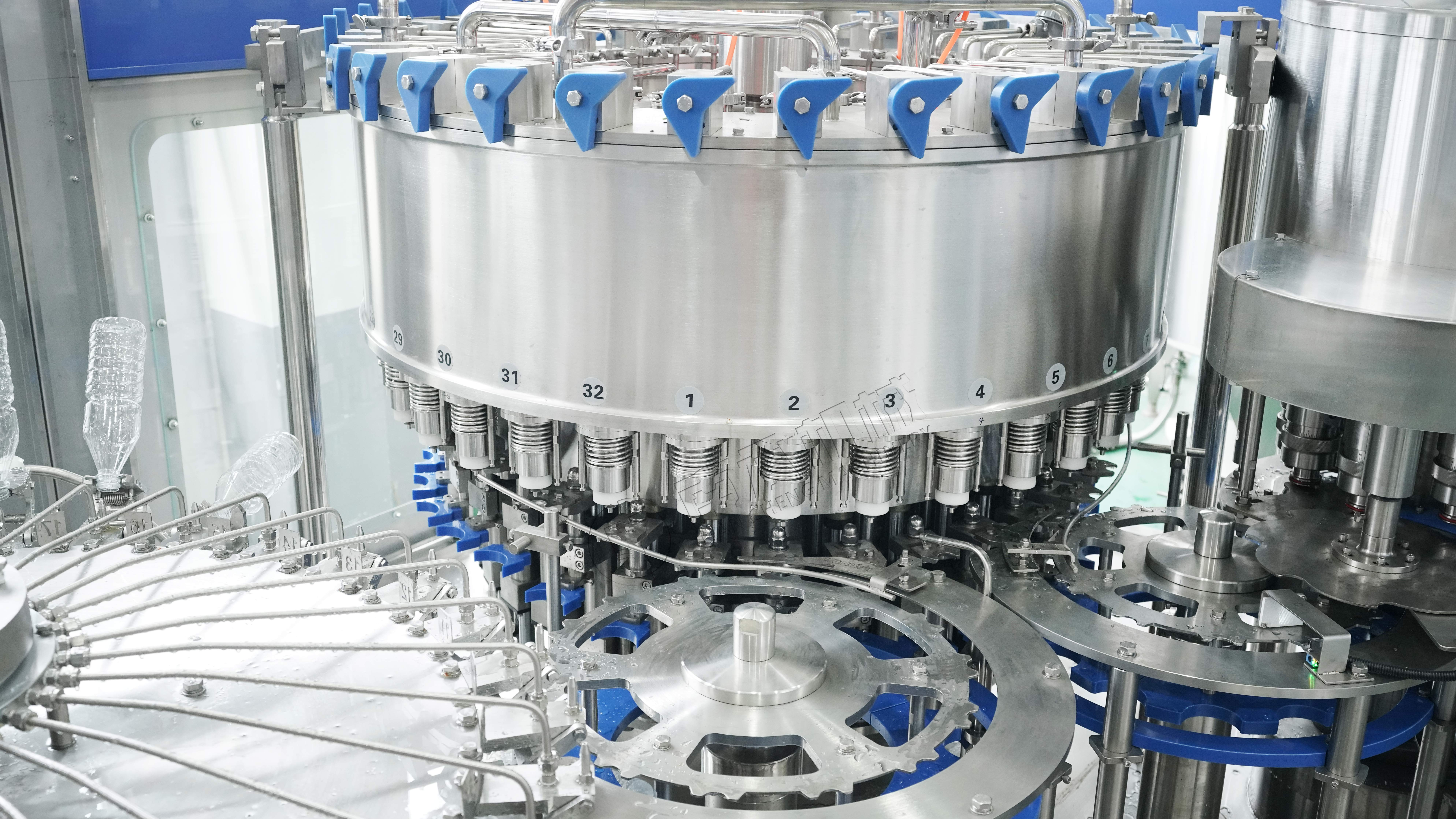
The core equipment of the production line is the 3-in-1 rinsing-filling-capping monoblock system.
This machine combines:
Bottle rinsing
Water filling
Cap sealing
inside one enclosed hygienic structure.
Water Filling Machine Price Reference
Filling Capacity
Estimated Cost
1,000–2,000 BPH
USD 10,000–15,000
3,000–6,000 BPH
USD 12,000–18,000
8,000–12,000 BPH
USD 15,000–28,000
24,000+ BPH
USD 72,000+
Choosing an experiencedwater filling machine manufactureris extremely important because filling stability directly affects production efficiency, hygiene, downtime, and maintenance costs.
For standard bottled water production, gravity filling remains the most stable and cost-effective solution.
Labeling and Packaging Machine Cost
Brazilian bottled water companies commonly use:
OPP wrap-around labels
Sleeve labels
Adhesive sticker labels
For high-volume bottled water production, OPP labeling is usually the most economical solution because it offers lower label material cost and high-speed operation.
Labeling Machine Cost Reference
Machine Type
Estimated Cost
Sticker labeling machine
USD 6,000–35,000
Sleeve labeling machine
USD 15,000–40,000
OPP labeling machine
USD 40,000–80,000
Laser coding machine
USD 6,000–12,000
Laser coding systems are increasingly popular in Brazil because they eliminate ink consumables and avoid smudging in humid environments.
Packaging Machine Cost Reference
Packaging System
Estimated Cost
Semi-automatic shrink wrapper
USD 4,000–15,000
Automatic shrink wrapper
USD 15,000–50,000
Carton packing machine
USD 40,000–120,000
Robotic palletizer
USD 80,000–200,000+
Shrink film packaging remains the dominant packaging method across Brazil and Latin America because it provides:
Lower packaging cost
Faster packaging speed
Better transportation efficiency
Hidden Costs in Brazil: Taxes, Logistics and Infrastructure
Many first-time investors underestimate the hidden costs of building a factory in Brazil.
Hidden Costs Include
Cost Item
Description
Ocean freight
Shipping from China to Brazilian ports
Import duty
Depends on HS code and equipment category
IPI tax
Federal industrialized product tax
PIS/COFINS
Federal social contribution taxes
ICMS
State-level circulation tax
Customs clearance
Documentation and broker fees
Inland transportation
Port-to-factory delivery
Installation cost
Engineer travel and accommodation
Civil engineering
Flooring, drainage, pipelines, electrical work
Because Brazil’s import and tax system is relatively complex, investors should work closely with local customs brokers and experienced exporters.
Nancheng Machinery can assist with:
Packing lists
Commercial invoices
HS code references
Technical documents
Shipping coordination
to help simplify the import process.
Factory Infrastructure Cost
Besides machinery, investors must also budget for factory infrastructure.
Unlike trading companies, Nancheng Machinery operates its own manufacturing facility with:
CNC machining
Stainless steel fabrication
Electrical assembly
Factory Acceptance Testing (FAT)
This provides several advantages:
Factory-direct pricing
Better quality control
Stable spare parts supply
Faster technical communication
Customized engineering support
Factory Acceptance Testing (FAT)
Many Brazilian buyers worry about purchasing machinery from overseas suppliers because of installation and after-sales concerns.
Nancheng Machinery reduces this risk through complete FAT testing before shipment.
FAT testing may include:
Bottle conveying tests
Filling accuracy inspection
Capping testing
Label alignment testing
Shrink wrapping verification
PLC and HMI testing
Speed verification
Customers can join FAT through:
On-site factory inspection
Video conference testing
Sample production verification
This process helps ensure stable machine performance before shipment.
Installation, Training Support
Nancheng Machinery can provide:
Overseas installation support
Operator training
Mechanical installation guidance
Electrical commissioning
Maintenance training
Online technical support
Frequently Asked Questions About Water Bottling Line Cost in Brazil
How much does it cost to start a bottled water factory in Brazil?
A small bottled water plant in Brazil usually requires an investment between USD 50,000 and USD 150,000 depending on capacity, automation level, and bottle formats.
What is the best production capacity for a new investor?
For many new investors, 3,000–6,000 BPH is a balanced starting point because it combines moderate investment with strong growth potential.
What is the biggest operating cost?
PET preforms and caps are usually the largest recurring expense, followed by electricity and packaging materials.
Is OPP labeling popular in Brazil?
Yes. OPP wrap-around labeling is widely used because it offers lower material costs and high-speed production efficiency.
How can I reduce operating costs?
You can reduce operating costs through:
Lightweight bottle design
OPP labels
Energy-saving blow molding systems
Air recycling technology
Efficient factory layout planning
Request Your Customized Water Bottling Plant Proposal
Every bottled water project in Brazil is different. Final investment depends on water quality, production capacity, bottle types, packaging style, electricity conditions, and local regulations.
Nancheng Machinery can provide:
Equipment configuration recommendations
Factory layout drawings
Utility consumption analysis
ROI calculations
Packaging optimization suggestions
Technical quotations
Video references
Contact Nancheng Machinery today to receive a customized turnkey water bottling plant proposal for your Brazil project.
 English
 العربية
 Français
 Русский
 Español
 Português
 Deutsch
 italiano
 Nederlands
 Tiếng Việt
 ไทย
ไทย Polski
 Türkçe
 አማርኛ
አማርኛ Bahasa Melayu
 Filipino
 Bahasa Indonesia
 magyar
 Română
 Čeština
 Монгол
 қазақ
қазақ Српски
 हिन्दी
 فارسی
فارسی Kiswahili
 Slovenčina
 Slovenščina
 Norsk
Norsk Svenska
 українська
 Suomi
Suomi Հայերեն
 Dansk
Dansk اردو
اردو Shqip
Shqip বাংলা
বাংলা Hrvatski
 Eesti keel
 සිංහල
සිංහල नेपाली
 Oʻzbekcha
 latviešu
 Azərbaycan dili
 Български
 ქართული
 Hausa
Hausa Igbo
Igbo Lietuvių
 Soomaali
 Yorùbá